
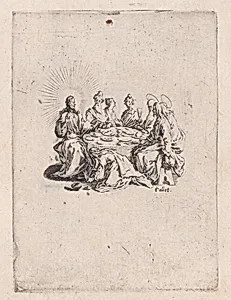
Le Repas Chez le Pharisien (The Meal at the Home of the Pharisee), from Les Quatre Banquets (The Four Feasts)
ca. 1625
Medium
Etching and engraving; first state of two (Lieure)
Dimensions
Sheet: 7 5/16 x 10 1/2 in. (18.5 x 26.6 cm) Plate: 2 15/16 x 2 3/16 in. (7.5 x 5.5 cm)
Classification
Prints
Department
Drawings and Prints
Museum
Metropolitan Museum of Art, New York, NY
Credit
Bequest of Edwin De T. Bechtel, 1957
Accession Number
57.650.358(2)
Rights
Public Domain
Art Historical Context
Jacques Callot's *Le Repas Chez learisien (The Meal the Home of the Pharise)*, created around 1625, captures a pivotal biblical moment from the Gospel of Luke (7:36–50). Part of the series *Lesatre Banquets (The Four Feasts)*, it depicts Jesus dining at the home of Pharisee Simon, where a sinful woman anoints his feet ointment—an act of profound devotion that sparks theological debate. Callot, a masterful French etcher from the Lorraine school active during the Baroque era, drew from religious narratives to explore human emotion and social dynamics in crowded, theatrical compositions. This first-state impression (as cataloged by Lieure) exemplifies Callot's innovative printmaking prowess. Measuring just 2 15/16 x 2 3/16 inches on the plate, the etching and engraving technique allowed for extraordinary fine lines and intricate details, packing a banquet scene with dozens of expressive figures into a miniature format. Callot's skill in combining etching's fluid lines with engraving's precision made his prints highly influential, bridging painting and reproductive art for a wide audience. Housed in the Metropolitan Museum of Art's Drawings and Prints department (Bequest of Edwin De T. Bechtel, 1957), this work highlights Callot's enduring legacy in elevating print as a vehicle for narrative depth and moral reflection, inviting viewers to ponder faith amid everyday opulence.
About the Artist
Jacques Callot · 1592–1635
Jacques Callot (1592–1635) was a French printmaker and draftsman from the Duchy of Lorraine, widely regarded as one of the first great artists to practice the graphic arts exclusively. His more than 1,400 etchings chronicled the breadth of 17th-century life, from Medici court festivities to the brutal realities of warfare. Callot revolutionized etching through technical innovations including the é...