
Le Réveil
1891
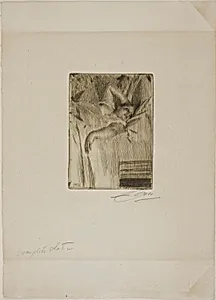
Medium
Etching on ivory laid paper
Dimensions
Image/plate: 13.7 × 10 cm (5 7/16 × 3 15/16 in.); Sheet: 35.1 × 25.4 cm (13 7/8 × 10 in.)
Classification
etching
Department
Prints and Drawings
Museum
Art Institute of Chicago
Accession Number
41614
Rights
Public Domain
Art Historical Context
Anders Zorn's *Le Réveil* (The Awakening), created in 1891, is a masterful etching that exemplifies the Swedish artist's prowess in printmaking during the late 19th century. Known for his luminous portraits, nudes, and genre scenes, Zorn bridged Realism and Impressionism, often capturing intimate moments with remarkable sensitivity to light and flesh tones. This small-scale work, measuring just 13.7 × 10 cm on ivory laid paper, invites viewers into a private, evocative scene, showcasing his international appeal—he exhibited widely in Europe and the United States, earning acclaim from peers like Sargent and Whistler. Etching allowed Zorn to achieve extraordinary detail and texture through intricate line work and subtle aquatint tones, techniques he perfected to rival painting's richness. Printed on a larger sheet (35.1 × 25.4 cm), *Le Réveil* highlights the revival of printmaking as a fine art, where artists like Zorn elevated the medium beyond reproduction. Housed in the Art Institute of Chicago's Prints and Drawings department, it reflects the era's fascination with naturalism and the female form, blending technical virtuosity with sensual elegance. A gem for collectors, this piece underscores Zorn's legacy as one of the greatest etchers of his time, producing over 130 plates celebrated for their immediacy and psychological depth.
About the Artist
Anders Zorn · 1860–1920
Anders Zorn (1860–1920), one of Sweden's most celebrated artists, was born on February 18 in Utmeland near Mora in Dalarna, and raised on his maternal grandparents' farm in the nearby hamlet of Yvraden. Displaying prodigious talent from a young age, he attended school in Mora Strand until age twelve, followed by secondary grammar school in Enköping, where he excelled in drawing people and horses. ...