
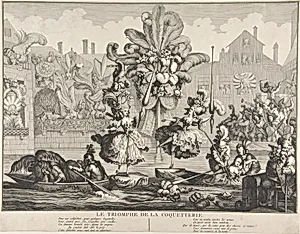
Le triomphe de la coquetterie
Medium
Etching and engraving
Dimensions
sheet: 14 3/4 x 19 in. (37.5 x 48.3 cm)
Classification
Prints
Department
Drawings and Prints
Museum
Metropolitan Museum of Art, New York, NY
Credit
The Elisha Whittelsey Collection, The Elisha Whittelsey Fund, 1960
Accession Number
60.625.1
Rights
Public Domain
Tags
Art Historical Context
"Le Triomphe de la Coterie" (The Triumph of Coqu), an enchanting 18th-century print the Metropolitan Museum of Art's Drawings and Prints department, captures the whimsical spirit of its era. Created anonymously by artists linked to both French and British traditions, etching and engraving on a generous sheet measuring 14¾ x 19 inches depicts a lively scene featuring women, boats, and buildings. The title playfully celebrates coquetry—flirtation and feminine charm—a popular motif in Rococo-influenced art, reflecting the lighthearted social satire of Enlightenment Europe. Etching and engraving techniques allowed for intricate details and tonal depth, making prints like this accessible to a wide audience beyond elite paintings. These methods combined etched lines for spontaneity with engraved precision for fine textures, ideal for bustling compositions evoking parades or triumphs. Amidst grand architecture and vessels on water, the work likely nods to 18th-century festivities or allegorical processions, where women embodied allure and wit. Acquired through The Elisha Whittelsey Collection in 1960, this piece offers a window into cross-cultural printmaking exchanges between France and Britain. Visitors will delight in its nod to the era's fascination with romance and revelry, a testament to print's role in disseminating cultural commentary.
About the Artist
Anonymous, French, 18th century|Anonymous, British, 18th century · 1700–1800
The artist known as Anonymous, French, 18th century, represents a collective of unidentified talents active roughly between 1700 and 1800, a period of profound artistic evolution in France from the opulent Rococo to the austere dawn of Neoclassicism and Revolutionary fervor. Little is documented about their personal training or mentors, as their anonymity obscures individual biographies, though th...