
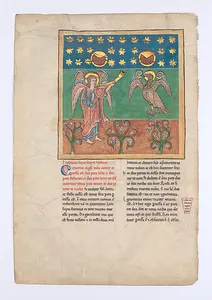
Leaf from a Beatus Manuscript: the Fourth Angel Sounds the Trumpet and an Eagle Cries Woe
Unknown Artist
ca. 1180
Medium
Tempera, gold, and ink on parchment
Dimensions
Overall (folio): 17 1/2 x 11 13/16 in. (44.4 x 30 cm) Mat: 22 x 16 in. (55.9 x 40.6 cm)
Classification
Manuscripts and Illuminations
Culture
Spanish
Department
The Cloisters
Museum
Metropolitan Museum of Art, New York, NY
Credit
Purchase, The Cloisters Collection, Rogers and Harris Brisbane Dick Funds, and Joseph Pulitzer Bequest, 1991
Accession Number
1991.232.9
Rights
Public Domain
Tags
Art Historical Context
This vibrant leaf from a Beatus Manuscript, created around 1180 in medieval Spain, captures a dramatic moment from the Book of Revelation in the Bible: the fourth angel its trumpet, unleashing cosmic destruction, while an eagle soars above crying "Woe, woe, woe" to herald further tribulations (Revelation 8:13). Beatus Manuscripts, inspired by the 8th-century commentary of Beatus of Liéb, were a uniquely Spanish phenomenon, produced in monastic scriptoria during the Romanesque period. They served as devotional tools for monks and clergy, vividly illustrating the Apocalypse to inspire awe and repentance amid the turbulent Reconquista era. Crafted with tempera paints, gold leaf, and ink on parchment, the artwork exemplifies the opulent techniques of illuminated manuscripts. The gold heightens the ethereal quality of angels and the eagle, while bold colors and dynamic compositions—hallmarks of Beatus style—create a sense of chaotic energy, with swirling stars falling and fiery hail. At 17½ x 11⅞ inches, this single folio leaf showcases the meticulous labor of anonymous scribes and artists, blending text and image in a harmonious yet terrifying vision. Housed in The Cloisters at the Metropolitan Museum of Art, this page highlights Spain's rich tradition of apocalyptic art, influencing later medieval illumination across Europe. Its survival offers a window into 12th-century spirituality, where divine judgment was rendered in jewel-like splendor.