
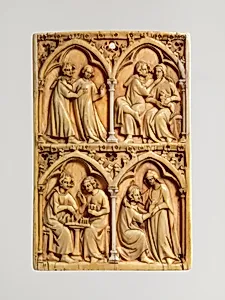
Leaf of a Writing Tablet
Unknown Artist
14th century
Medium
Ivory
Dimensions
Overall: 4 9/16 x 3 1/16 x 3/16 in. (11.7 x 7.8 x 0.6 cm)
Classification
Ivories
Culture
French
Department
Medieval Art
Museum
Metropolitan Museum of Art, New York, NY
Credit
Gift of Ann Payne Blumenthal, 1938
Accession Number
38.108
Rights
Public Domain
Tags
Art Historical Context
This delicate *Leaf of a Writing Tablet*, crafted in the 14th century by unknown French artist, exemplifies exquisite ivory carvings of medieval Europe. Measuring just 4 9/16 x 3 1/16 x 3/16 inches, this thin panel would have formed one side of a portable diptych writing tablet. A shallow recess on the reverse held beeswax for jotting notes with a stylus, making it a practical luxury item for nobles, merchants, or clergy. Donated to the Metropolitan Museum of Art in 1938 by Ann Payne Blumenthal, it now resides in the Medieval Art department. The artwork's surface features finely incised reliefs of couples, men, and women, evoking the courtly culture of Gothic France. Produced likely in Parisian workshops—renowned centers for ivory production—these scenes reflect secular themes of romance and daily life, contrasting with the era's dominant religious art. Ivory, sourced from elephant tusks, was prized for its creamy smoothness and workability, allowing artists to achieve intricate details with chisels and knives. Such tablets highlight medieval innovation in personal accessories, blending utility with artistry. They were status symbols, often personalized and carried in pockets or pouches, offering a glimpse into the intimate, refined world of 14th-century French society.