
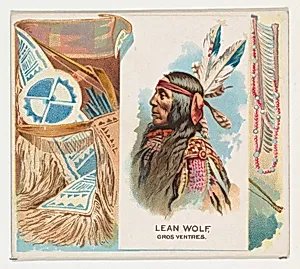
Lean Wolf, Gros Ventres, from the American Indian Chiefs series (N36) for Allen & Ginter Cigarettes
1888
Medium
Commercial color lithograph
Dimensions
Sheet: 2 7/8 x 3 1/4 in. (7.3 x 8.3 cm)
Classification
Prints|Ephemera
Department
Drawings and Prints
Museum
Metropolitan Museum of Art, New York, NY
Credit
The Jefferson R. Burdick Collection, Gift of Jefferson R. Burdick
Accession Number
63.350.202.36.10
Rights
Public Domain
Tags
Art Historical Context
In 1888, the tobacco company Allen & Ginter issued the *American Indian Chiefs* series (N36), a set of collectible trading cards inserted into cigarette packs to entice smokers and spark a collecting frenzy. This vibrant chromolithograph features *Lean Wolf, Gros Ventres*, portraying the Native American leader in profile, capturing his dignified presence amid the era's romanticized fascination with the American West. The Gros Ventres, or Atsina people, were allies of the Arapaho, and such cards immortalized chiefs like Lean Wolf during a time of rapid cultural upheaval for Indigenous nations. Produced as commercial color lithographs—a pioneering technique allowing mass reproduction of vivid, multi-hued images on a tiny scale (just 2 7/8 x 3 1/4 inches)—these ephemera cards blended artistry with marketing. Chromolithography's precision brought portraits to life with striking detail, making them accessible souvenirs a vanishing frontier, often inspired by photographs from Wild West shows. Today, this card resides in the Metropolitan Museum of Art's Jefferson R. Burdick Collection, a treasure trove of American print ephemera. It offers a window into late 19th-century popular culture, where tobacco ads preserved Indigenous likenesses, blending commerce, portraiture, and historical memory for modern visitors.
About the Artist
Allen & Ginter
Allen & Ginter, the pioneering American tobacco firm based in Richmond, Virginia, emerged around 1880 from the partnership of John F. Allen and Lewis Ginter, evolving from Allen's earlier John F. Allen & Company. Allen retired in 1882, succeeded by John Pope, yet the brand endured under Ginter's leadership, employing over 1,100 workers—mostly women—for hand-rolled cigarettes by 1886. Ginter, a Dut...