
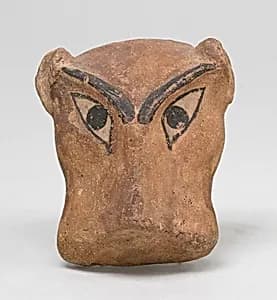
Leopard's Head from Priest's Robe
Unknown Artist
ca. 1550–1295 B.C.
Medium
Pottery
Dimensions
L. 8.8 cm (3 7/16 in.); W. 7.2 cm (2 3/16 in.)
Classification
Leopard's Head from Priest's Robe
Period
New Kingdom
Department
Egyptian Art
Museum
Metropolitan Museum of Art, New York, NY
Credit
Rogers Fund, 1912
Accession Number
12.181.281
Rights
Public Domain
Tags
Art Historical Context
This exquisite pottery leopard's head, to Egypt's New Kingdom Dynasty 18 (ca. 1550–1295 B.), once adorned a priest's ceremonial robe. Crafted at a modest scale—8.8 cm long and 7.2 cm wide—it exemplifies the intricate appliqués used in ritual garments. During this golden age of pharaonic power, under rulers like Hatshepsut and Tuthamun, high priests donned leopard skins over their shoulders to invoke the animal's fierce protection and divine ferocity, linking them to gods such as Anubis or the warrior goddess Sekhmet. Modeled from fired clay, the piece showcases ancient Egyptian pottery techniques: careful hand-building to capture the leopard's snarling muzzle, alert ears, and textured fur, then glazed or polished for a lifelike sheen. Such ornaments blended functionality with symbolism, transforming everyday pottery—a staple medium for durable, mass-producible items—into sacred art. The mask-like form hints at its role in temple rituals, where priests embodied protective spirits. Acquired through the Rogers Fund in 1912, this artifact from the Metropolitan Museum of Art's Egyptian collection offers a tactile glimpse into the mystical world of ancient worship, reminding us how everyday materials elevated religious drama.