
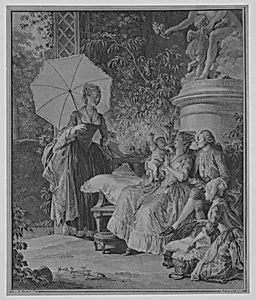
Les Délices de la Maternité (Maternal Pleasure), from Le Monument du Costume
Medium
Etching and engraving; third state of five (Bocher)
Dimensions
Sheet: 15 11/16 × 12 in. (39.8 × 30.5 cm)
Classification
Prints
Department
Drawings and Prints
Museum
Metropolitan Museum of Art, New York, NY
Credit
Harris Brisbane Dick Fund, 1930
Accession Number
30.63
Rights
Public Domain
Tags
Art Historical Context
**Les Délices de laaternité (Maternal)**, created in 1777, is a captivating print from *Le Monument du Costume*, renowned series that chronicled historical and contemporary fashions. Engraved primarily by Jean-Michel Moreau the—a master of French Rococo and early Neoclassical illustration—with contributions from writer Restif de la Bretonne, printer l'Imprimerie deult, and engraverore Stanislas Henri Helman, this work captures the tender joys of motherhood amid 18th-century elegance. The third state of five (as cataloged by Bocher) reflects the meticulous refinement typical of such collaborative printmaking endeavors. Depicting mothers, infants, women, and men in a sunlit outdoor setting—complete with parasols for fashionable shade—the etching and engraving evokes the era's idealization of domestic bliss and social grace. Just before the French Revolution, such images celebrated aristocratic leisure and family life, serving as both artistic documents and aspirational fashion plates. Measuring 15 11/16 × 12 inches, its intricate lines showcase Moreau's skill in rendering delicate fabrics, expressive faces, and dynamic compositions. Housed in the Metropolitan Museum of Art's Drawings and Prints department (Harris Brisbane Dick Fund, 1930), this print offers a window into pre-Revolutionary France, blending technical precision with cultural nostalgia. Visitors will appreciate its blend of whimsy and historical insight, a testament to printmaking's power to preserve fleeting moments of human delight.