
Les Héros de la Ligue ou La Procession Monacale, conduitte par Louis XIV pour la Conversion des Protestans de son Royaume
1691
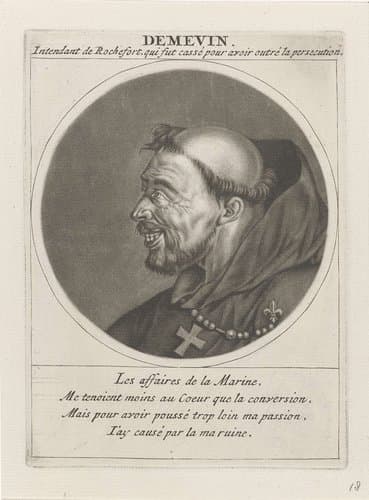
Medium
engraving
Dimensions
107; 146
Rights
Public Domain
About this artwork
Demevin met op zijn borst de Franse lelie. Hij draagt een pij. De prent maakt deel uit van een serie met spotprenten op Lodewijk XIV en zijn gevolg.
Art Historical Context
**Les Héros de la Ligue La Procession Monac**, created by Dutch engraver Jacobole in 1691, is a sharp satirical print measuring just 146 × 107 mm. As a skilled reproductive engraver active in Amsterdam, Gole excelled in intricate line work that captured fine details and biting commentary, making engravings like this ideal for widespread distribution during an era of political tension. The title mocks Louis XIV's aggressive policies, portraying a mock "monastic procession" led by Sun King to convert Protestants in his realm—likely alluding to the 1685 Revocation of the Edict of Nantes, which sparked Huguenot persecution and exodus. A figure named Demevin, adorned with the French fleur-de-lis on his chest and clad in a monk's robe, symbolizes the hypocritical blend of royal power and religious fervor. This piece belongs to a series of Dutch *spotprenten* (satirical prints) lampooning Louis XIV and his court, reflecting anti-French sentiment amid the Nine Years' War. Culturally, such small-scale engravings were potent tools for propaganda, circulating mockery of absolutism in Protestant Europe. Gole's precise technique amplifies the irony, inviting viewers to chuckle at the "heroes" of the League while pondering the era's religious strife. A witty window into 17th-century caricature!
About the Artist
Jacob Gole · 1660–1737
Jacob Gole (c. 1660-1737) was a Dutch engraver and mezzotinter renowned for his portrait engravings and his role in disseminating the mezzotint technique across Europe. Born in Paris to the celebrated Huguenot cabinetmaker Pierre Gole, he emerged as one of the most skilled printmakers of the late Dutch Golden Age. Gole's significance in art history lies primarily in his mastery of the mezzotint t...