
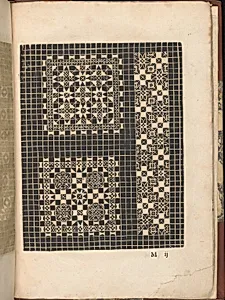
Les Secondes Oeuvres, et Subtiles Inventions De Lingerie du Seigneur Federic de Vinciolo Venitien, page 46 (recto)
Medium
Woodcut
Dimensions
Overall: 9 7/16 x 6 1/2 in. (24 x 16.5 cm)
Classification
Books|Prints|Ornament & Architecture
Department
Drawings and Prints
Museum
Metropolitan Museum of Art, New York, NY
Credit
Harris Brisbane Dick Fund, 1939
Accession Number
39.30(49)
Rights
Public Domain
Tags
Art Historical Context
Step into the intricate world of Renaissance lace design with page 46 (recto) from *Les Secondes Œuvres, et Subtiles Inventions de Lingerie* by Federico de Vinciolo, a Venetian master pattern-maker. Published in 1603, this woodcut print showcases delicate ornamental motifs destined for fine linens and undergarments—here termed "lingerie" in the elegant French of the era. Vinciolo's patterns, blending floral scrolls, geometric symmetries, and whimsical flourishes, reflect the opulent tastes of European courts during the late Renaissance. Collaborating with printer Jean Le Clerc and possibly under the patronage of Catherine de Bourbon, sister to King Henry IV of France, Vinciolo's book democratized high fashion. Woodcuts, a precise and reproducible technique, allowed these intricate designs to spread from Italian workshops to needleworkers across Europe, fueling the lace boom of the 17th century. Measuring just 9 7/16 x 6 1/2 inches, this page exemplifies the technical virtuosity of period printing, where fine lines captured motifs that skilled artisans would translate into sumptuous textiles. Today, housed in the Metropolitan Museum of Art's Drawings and Prints department (Harris Brisbane Dick Fund, 1939), it highlights the fusion of art and craft. These patterns weren't mere decoration—they symbolized status, technical prowess, and cultural exchange, bridging Venice's Renaissance legacy with France's emerging Baroque splendor. A testament to fashion's enduring artistry!
About the Artist
Federico de Vinciolo|Jean Le Clerc|Catherine de Bourbon (Italian| |French) · 1582 | |1558 –1599 | |1604
Italian, active Paris, ca. 1587–99| |French, 1558–1604