
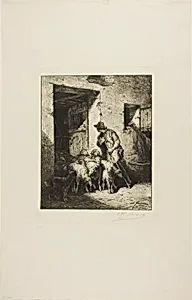
Letting the Sheep Out
Medium
Etching and aquatint on ivory wove paper
Dimensions
Image: 19.6 × 16.3 cm (7 3/4 × 6 7/16 in.); Plate: 22.9 × 18.1 cm (9 1/16 × 7 3/16 in.); Sheet: 44.1 × 27.8 cm (17 3/8 × 11 in.)
Classification
etching
Department
Prints and Drawings
Museum
Art Institute of Chicago
Accession Number
28587
Rights
Public Domain
Art Historical Context
In the serene etching *Letting the Sheep Out* (1876), French artist Charles Émile Jacque captures a quintessential moment of rural life. Jacque, a prominent member of the Barbizon School, was renowned for his realistic depictions of the French countryside, peasants, and livestock—especially sheep, which he portrayed with affectionate detail. Created during a time when industrialization was transforming Europe, this print evokes the timeless harmony of pastoral existence, reflecting the Barbizon artists' commitment to en plein air observation and naturalism as a counterpoint to urban upheaval. Jacque masterfully employs etching and aquatint techniques on ivory wove paper to achieve rich tonal depth and texture. Etching allows precise lines for the sheep's woolly forms and the shepherd's figure, while aquatint adds subtle washes of shadow, mimicking the soft light of dawn or dusk filtering through the scene. Measuring a modest 19.6 × 16.3 cm, the image invites intimate viewing, its fine details rewarding close inspection—a hallmark of 19th-century printmaking's accessibility for collectors and art lovers. Housed in the Art Institute of Chicago's Prints and Drawings Department, this work exemplifies Jacque's prolific output of over 1,300 etchings, blending technical virtuosity with a nostalgic celebration of agrarian traditions. It's a gentle reminder of simpler rhythms in an era of rapid change.