
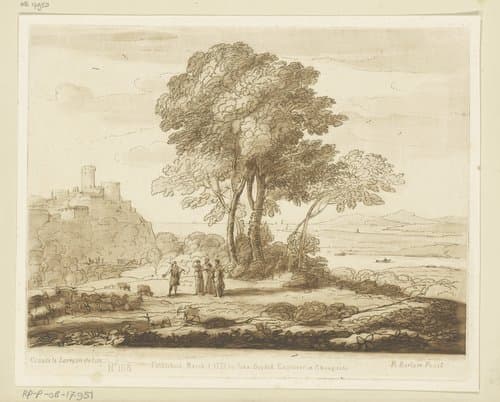
Liber Veritatis. Or a Collection of Two Hundred Prints, after the original designs of Claude le Lorrain (...)
1777-03-01
Medium
etching
Dimensions
207; 260
Rights
Public Domain
About this artwork
datum
Art Historical Context
Richard Earlom’s *Liber Veritatis* (1777) is a landmark series of reproductive prints that brought the celebrated landscape designs of seventeenth-century master Claude Lorrain to a new audience. Comprising two hundred etchings faithfully rendered after Claude’s own drawings, the publication served as both an artistic tribute and a practical record of the earlier artist’s compositions. By translating Claude’s delicate ink and wash studies into the crisp lines of etching, Earlom helped preserve and popularize the luminous, atmospheric qualities that made Claude’s work so influential across Europe. The project reflects the eighteenth-century enthusiasm for reproductive printmaking, a medium that allowed wider circulation of original artworks otherwise held in private collections. Earlom’s careful attention to light, tone, and spatial depth demonstrates etching’s capacity to convey subtlety while remaining accessible to collectors and students alike. Measuring just over 20 by 26 centimeters, each sheet was designed for intimate viewing, inviting close study of Claude’s masterful arrangements of trees, ruins, and distant horizons. Today the series stands as an important bridge between Baroque landscape tradition and later Romantic sensibilities, underscoring how reproductive prints shaped artistic taste and education in Earlom’s time.
About the Artist
Richard Earlom · 1728–1794
Richard Earlom (1743–1822) stands as one of the supreme masters of mezzotint engraving in British art history, whose technical virtuosity and dedication to reproductive printmaking brought the works of Old Masters to unprecedented audiences. Born in London on May 14, 1743, Earlom spent his entire career transforming paintings and drawings into prints of extraordinary quality, elevating reproductiv...