
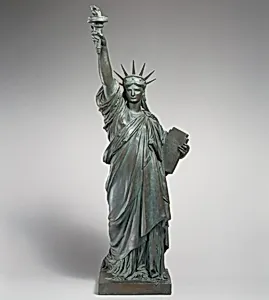
Liberty
Medium
Bronzed terracotta
Dimensions
wt. confirmed: 47 3/4 in., 56.4 lb. (121.3 cm, 25.6 kg)
Classification
Sculpture
Culture
French
Department
European Sculpture and Decorative Arts
Museum
Metropolitan Museum of Art, New York, NY
Credit
Gift of Julia Neville Adams Aubry (Mrs. Charles Georges Aubry), in memory of Jules Weber and his grandson, Charles George Aubry, 1999
Accession Number
1999.49
Rights
Public Domain
Tags
Art Historical Context
Frédéric-Auguste Bartholdi's *Liberty* (1875) is a striking bronzed terracotta sculpture captures the essence of one of the world's most iconic symbols. Standing at 47 3/4 inches tall and weighing 56.4 pounds, this exemplifies Bartholdi's mastery in sculpting monumental figures. As a French artist renowned for his colossal public monuments, Bartholdi crafted this piece during the planning stages of his most famous project: the Statue of Liberty, unveiled in New York Harbor in 1886 as a gift from France to the United States. The sculpture's historical significance lies in its role as a preparatory model (maquette) for the grand statue *Liberty Enlightening the World*. Created amid post-Civil War optimism and Franco-American alliance, it embodies Enlightenment ideals of freedom, democracy, and republicanism. Bartholdi's neoclassical style draws from ancient Roman and Greek precedents, with dynamic drapery and poised stance evoking strength and aspiration—perfect for a beacon of hope to immigrants. Crafted in terracotta coated with bronze for durability and luster, the medium allowed Bartholdi to refine proportions and details before scaling up to copper sheets. Now in the Metropolitan Museum of Art's European Sculpture and Decorative Arts collection, gifted in 1999, *Liberty* invites visitors to ponder the artistic vision behind a global emblem of liberty.