
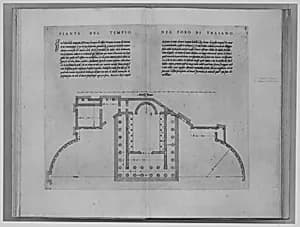
Libro d'Antonio Labacco appartenente a l'architettura nel qual si figurarano alcune notabili antiquita di Roma ...
Medium
Book of engraved plates, some typeset text with historiated woodcut initials.
Dimensions
16 9/16 × 11 × 11/16 in. (42 × 28 × 1.8 cm)
Classification
Books|Ornament & Architecture
Department
Drawings and Prints
Museum
Metropolitan Museum of Art, New York, NY
Credit
Rogers Fund, 1920
Accession Number
21.26
Rights
Public Domain
Tags
Art Historical Context
Step into the Renaissance fascination with ancient Rome through *Libro d'Antonio Lab appartenente a l'arch*, a stunning 1552 (or possibly 1558) volume by architect and engraver Antonio da Lab, with contributions from Mannerist painter Francescoviati (Francesco de Rossi). This elegantly bound book, measuring 16 9/16 × 11 × 11/16 inches, belongs to the Metropolitan Museum of's Drawings and Prints collection, acquired via the Rogers in 1920. It's a treasure of architectural documentation, blending precise engravings with typeset text and ornate historiated woodcut initials that evoke the era's love for classical ornament. Labacco's work captures "notabili antiquita di Roma"—notable Roman antiquities like temples, arches, and baths—through meticulously engraved plates. Produced amid the 16th-century revival of Vitruvian principles, it served scholars, architects, and artists hungry to reconstruct antiquity's grandeur. Figures like Palladio drew inspiration from such volumes, fueling the spread of Renaissance classicism across Europe. The engravings' fine lines allowed unprecedented accuracy in reproducing complex details, from capitals to entablatures, while Salviati's flair likely infused decorative elements with Mannerist elegance. This book isn't just a catalog; it's a bridge between Rome's imperial past and the innovative designs of the future, inviting visitors to trace the roots of Western architecture.
About the Artist
Antonio da Labacco|Francesco Salviati (Francesco de' Rossi) (Italian|Italian (born Spain)) · 1495 |1478 –1567 |1562
Italian, near Vigevano ca. 1495–after 1567|Salamanca 1478–1562 Rome