
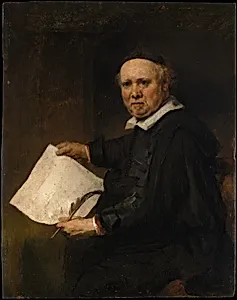
Lieven Willemsz van Coppenol (born about 1599, died 1671 or later)
Medium
Oil on oak
Dimensions
14 3/8 x 11 3/8 in. (36.5 x 28.9 cm)
Classification
Paintings
Department
European Paintings
Museum
Metropolitan Museum of Art, New York, NY
Credit
Bequest of Mary Stillman Harkness, 1950
Accession Number
50.145.33
Rights
Public Domain
Tags
Art Historical Context
This intimate portrait by Rembrandt van Rijn capturesven Willemsz vanpenol, a figure from the Dutch Golden Age born around 1599 and living at least until 1671. Painted in oil on oak—a favored medium for small-scale works in 17th-century Netherlands—the painting measures just 14⅜ × 11⅜ inches, suggesting it was likely a personal commission or study. Rembrandt, the preeminent Baroque master of light and shadow, excelled at such compact portraits, infusing them with profound psychological depth and lifelike presence. Rembrandt's technique shines here through his masterful chiaroscuro, where dramatic contrasts of light and dark draw the eye to Coppenol's expressive face and attire, evoking the subject's character and status. As a portrait from the European Paintings collection at The Metropolitan Museum of Art (bequest of Mary Stillman Harkness, 1950), it exemplifies the Dutch artist's innovative approach to individualism during a prosperous era of trade and humanism. Though the exact date remains unknown, the work reflects Rembrandt's enduring fascination with human expression, making it a gem for visitors seeking the emotional intensity of Golden Age portraiture.
About the Artist
Rembrandt (Rembrandt van Rijn) · 1606–1669
Rembrandt Harmenszoon van Rijn (1606–1669) stands as one of the greatest visual artists in the history of Western art and the most important Dutch painter of the 17th century. Born in Leiden to a prosperous miller's family, Rembrandt transformed painting through his revolutionary use of light and shadow, his psychological depth in portraiture, and his elevation of etching to a fine art. His approx...