
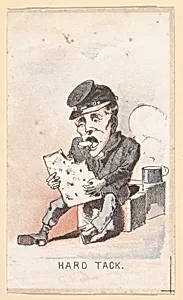
Life in Camp, Part 1: Hard Tack
Medium
Color lithograph
Dimensions
Sheet: 4 1/8 x 2 3/8 in. (10.4 x 6.1 cm)
Classification
Prints|Ephemera
Department
Drawings and Prints
Museum
Metropolitan Museum of Art, New York, NY
Credit
The Jefferson Burdick Collection, Gift of Jefferson Burdick, 1947
Accession Number
47.91.25(179)
Rights
Public Domain
Tags
Art Historical Context
In 1864, amid the grueling American Civil War, Winslow Homer captured the gritty realities of soldiering in *Life in Camp, Part 1: Hard Tack*, a color lithograph produced by the innovative printers Louis Prang & Co. This petite print (just 4 1/8 x 2 3/8 inches) depicts Union soldiers gathered around a makeshift meal of hard tack—the infamously tough, weevil-ridden biscuit that sustained troops but tested their endurance. As part of a series illustrating camp life, it offers a rare, intimate glimpse into the daily hardships far from the battlefield's drama. Homer, renowned for his realistic portrayals of Civil War scenes, drew from his own experiences as a Harper's Weekly correspondent embedded with the Union Army. The artwork's historical significance lies in its documentation of ordinary privations, humanizing the soldiers as weary men sharing scarce rations. Hard tack symbolized the monotony and resilience of wartime existence, evoking the era's food scarcity and the soldiers' ingenuity in softening the rock-like bread with coffee or bullets. Printed as ephemera—likely for collectors or publications—via chromolithography, a technique Prang mastered for vibrant, affordable color reproduction, this piece exemplifies 19th-century printmaking's role in disseminating art to the masses. Housed in the Metropolitan Museum of Art's Jefferson Burdick Collection, it reminds us how such small-scale works preserved the war's human stories for posterity.
About the Artist
Winslow Homer|Louis Prang & Co. · 1836–1910
Winslow Homer (1836-1910) was one of America's greatest painters and a preeminent figure in 19th-century American art. Largely self-taught, Homer began his career as a commercial illustrator and Civil War correspondent for Harper's Weekly before becoming renowned for his powerful marine subjects and landscape paintings. His mastery of both oil and watercolor, combined with his uncompromising reali...