
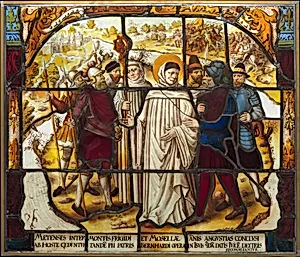
Life of Saint Bernard of Clairvaux: Saint Bernard mediates a dispute between Bishop Stephan von Bar and Duke Matthew von Lothringen in Metz (one of two)
Unknown Artist
after 1535
Medium
Stained glass
Dimensions
Overall (confirmed, with brass framing): 28 5/8 x 33 3/8 in. (72.7 x 84.8 cm); Other (brass support extends behind panel): 3/8 in. (1 cm); Other (thickness of brass framing): 3/8 in. (1 cm)
Classification
Glass-Stained
Culture
German, Cologne
Department
European Sculpture and Decorative Arts
Museum
Metropolitan Museum of Art, New York, NY
Credit
Gift of Stanley Mortimer, 1959
Accession Number
59.183.1
Rights
Public Domain
Tags
Art Historical Context
This vibrant stained glass panel, created in Cologne, Germany, after 5, captures a pivotal moment from the *Life of Saint Bernard ofvaux*. It depicts the 12th-century Cistercian monk and theologian mediating a heated dispute between Bishop Stephan von and Duke Matthew von Lothringen in the city of Metz. As one of two panels on this theme, it exemplifies medieval hagiography—sacred biographies that celebrated saints' virtues through dramatic vignettes. Saint Bernard, revered for his eloquence and piety, often intervened in noble conflicts, underscoring the Church's role in secular politics during the Middle Ages. Crafted in the renowned Cologne glassmaking tradition, the work showcases 16th-century techniques: richly colored pot-metal glass for bold figures and backgrounds, with enamel paints adding fine details like facial expressions and robes. Framed in brass and measuring about 28½ x 33⅜ inches, it would have illuminated a church window, transforming sunlight into a glowing narrative for worshippers. Cologne's workshops produced such panels amid the Renaissance, blending Gothic storytelling with emerging naturalism, even as Reformation tensions brewed nearby. A generous gift to The Metropolitan Museum of Art in 1959, this anonymous masterpiece preserves a slice of devotional art, inviting us to reflect on faith's power to bridge divides.