
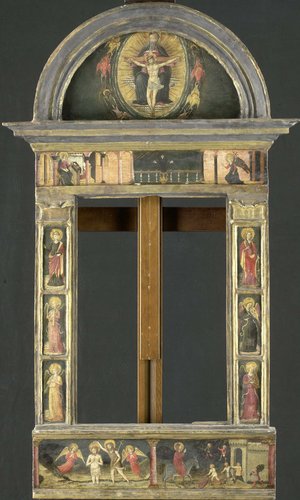
Lijst beschilderd met de verkondiging, de doop van Christus, de intocht in Jeruzalem, de heiligen Cecilia en Catharina, de genadestoel en vier musicerende engelen
1450 - 1460
Medium
poplar (wood)
Dimensions
86.2; 146; 15.3
Rights
Public Domain
About this artwork
hoogte 146 cm x breedte 86,2 cm x diepte 15,3 cm
Art Historical Context
This painted wooden frame, created by the Florentine artist Giovanni di Francesco del Cervelliera between 1450 and 1460, exemplifies the rich tradition of Early Renaissance religious art. Crafted from poplar and measuring over a meter and a half in height, the frame was designed to surround a central devotional image—likely an altarpiece—while itself serving as a narrative and spiritual extension of that work. Its surfaces feature carefully arranged scenes from Christ’s life, including the Annunciation, the Baptism, and the Entry into Jerusalem, alongside saints Cecilia and Catherine, the Throne of Grace, and four music-making angels. Such elaborately decorated frames were common in fifteenth-century Italy, where every element of an altarpiece contributed to the viewer’s meditation and worship. The inclusion of musical angels and the Throne of Grace suggests the frame was meant to evoke heavenly harmony and divine presence, guiding the faithful from earthly scenes toward celestial glory. Giovanni’s delicate handling of these small-scale figures reflects the period’s growing interest in naturalistic detail and balanced composition. Today preserved in the Rijksmuseum, the frame offers a rare glimpse into how Renaissance artists integrated painting, sculpture, and architecture to create immersive sacred environments. Its survival reminds us that even the borders of religious artworks carried profound meaning for their original audiences.