
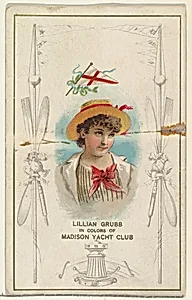
Lillian Grubb in Colors of Madison Yacht Club, from the Yacht Colors of the World series (N140) issued by Duke Sons & Co. to promote Honest Long Cut Tobacco
Medium
Commercial color lithograph
Dimensions
Sheet: 4 in. × 2 1/2 in. (10.1 × 6.3 cm)
Classification
Prints|Ephemera
Department
Drawings and Prints
Museum
Metropolitan Museum of Art, New York, NY
Credit
The Jefferson R. Burdick Collection, Gift of Jefferson R. Burdick
Accession Number
63.350.207.140.60
Rights
Public Domain
Tags
Art Historical Context
Step into the vibrant world of 1890s advertising with *Lillian Grubb in of Madison Yacht Club*, charming commercial color lithograph from W. Duke Sons & Cos *Yacht Colors of the* series (N140). Issued promote Honest Long Cut Tobacco this petite print (just 4 × 2½ inches) captures Lillian Grubb, likely a prominent figure associated with the Madison Yacht Club, adorned the club's distinctive flag colors. Produced as collectible ephemera, cards were tucked into tobacco packages, sparking a collecting craze among Americans fascinated by yachting culture and global maritime symbols. Chromolithography, the era's breakthrough printing technique, allowed for vivid, multi-layered colors on a mass scale, transforming everyday ads into miniature artworks. Duke's series celebrated nautical pride, blending portraiture with patriotic flags to evoke the Gilded Age's seafaring glamour and emerging consumer culture. Women like Grubb often symbolized elegance and club prestige, making these cards both promotional tools and windows into social hierarchies. Today, housed in the Metropolitan Museum of Art's Jefferson R. Burdick Collection, this ephemera highlights how commerce fueled popular art, bridging high culture and everyday life in late 19th-century America. A delightful snapshot of history in your hand!
About the Artist
W. Duke, Sons & Co. · 1870–1920
**W. Duke, Sons & Co.: Pioneers of Chromolithographic Trade Card Art** W. Duke, Sons & Co., an American tobacco manufacturer, emerged from the entrepreneurial vision of Washington Duke (1820–1905) and his sons in Durham, North Carolina. After the Civil War, Washington abandoned farming in 1874 to join his eldest son, Brodie L. Duke, in the burgeoning tobacco trade, establishing a factory that for...