
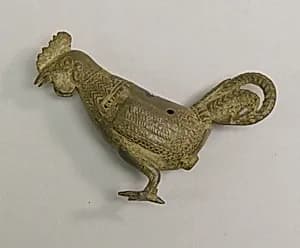
Lime Vessel in the Form of a Cock
Unknown Artist
500 BCE–300 CE
Medium
Bronze
Dimensions
H. 3 1/8 in. (7.9 cm); W. 1 1/2 in. (3.8 cm); L. 4 11/16 in. (11.9 cm)
Classification
Metalwork
Culture & Period
Indonesia (Java, Lumajang, Pasiran) · Bronze and Iron Age period
Department
Asian Art
Museum
Metropolitan Museum of Art, New York, NY
Credit
Samuel Eilenberg Collection, Bequest of Samuel Eilenberg, 1998
Accession Number
2001.433.519
Rights
Public Domain
Tags
Art Historical Context
This exquisite bronze lime vessel, crafted in the form of a rooster, hails from ancient Java in Indonesia, specifically the Lumajang-Pasiran region, during Bronze and Iron Age ( BCE–300 CE). just 3⅛ inches tall, this diminutive metalwork masterpiece exemplifies the sophisticated casting techniques of early Southeast Asian artisans. The rooster's alert posture, with detailed feathers, comb, and wattles, captures the bird's vigilant spirit, transforming a utilitarian object into a lively zoomorphic sculpture. Lime vessels like this were essential for betel-chewing rituals, a widespread cultural practice in ancient Indonesia where lime paste facilitated the chewing of betel nuts for social, medicinal, and ceremonial purposes. The choice of bronze—a durable alloy—highlights the era's advanced metallurgy, likely achieved through lost-wax casting, allowing for intricate details in such a compact form (4⅞ inches long). Roosters, symbols of dawn and protection in many Asian traditions, add symbolic depth to its functional design. Now part of the Metropolitan Museum of Art's Samuel Eilenberg Collection, this rare artifact offers a glimpse into Java's vibrant prehistoric artistry, bridging everyday life and artistic expression in one of Asia's earliest metalworking hubs.