
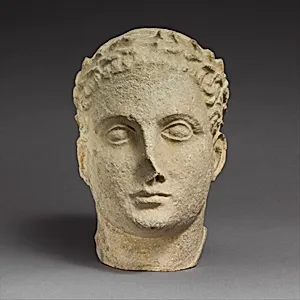
Limestone head of beardless male votary
Unknown Artist
2nd century BCE
Medium
Limestone
Dimensions
Overall: 10 1/4 x 6 3/4 x 9 in. (26 x 17.1 x 22.9 cm)
Classification
Stone Sculpture
Culture & Period
Cypriot · Hellenistic
Department
Greek and Roman Art
Museum
Metropolitan Museum of Art, New York, NY
Credit
The Cesnola Collection, Purchased by subscription, 1874–76
Accession Number
74.51.2799
Rights
Public Domain
Tags
Art Historical Context
This striking limestone head depicts a beardless male vot from ancient Cyprus, carved in the 2nd century BCE during Hellenistic period. Measuring about 10 inches tall, it captures the youthful figure with a serene expression, his hair neatly styled and crowned with a wreath—a common symbol of devotion in religious rituals. Votaries like this offered sculptures as vows to deities, often Aphrodite, Cyprus's patron goddess, reflecting the island's vibrant spiritual life at the crossroads of Greek, Egyptian, and Near Eastern influences. Hellenistic Cypriot art blended classical Greek realism with local traditions, evident in the head's finely detailed features: smooth skin, almond-shaped eyes, and subtle modeling that conveys quiet piety. Limestone, abundant on the island, was a practical choice for durable votive offerings placed in sanctuaries. This piece, part of the Cesnola Collection at The Metropolitan Museum of Art, highlights Cyprus's role as a cultural melting pot after Alexander the Great's conquests. Such sculptures remind us of everyday piety in the ancient world, where ordinary devotees commissioned portraits to eternalize their faith. Gaze into those calm eyes, and you'll sense the timeless human impulse to connect with the divine.