
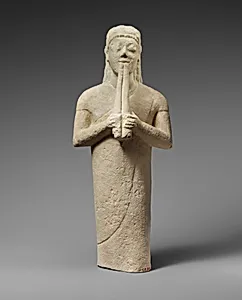
Limestone statuette of a male aulos player
Unknown Artist
middle or 3rd quarter of the 6th century BCE
Medium
Limestone
Dimensions
Overall: 13 1/2 x 5 1/2 x 3 3/4 in. (34.3 x 14 x 9.5 cm)
Classification
Stone Sculpture
Culture & Period
Cypriot · Archaic
Department
Greek and Roman Art
Museum
Metropolitan Museum of Art, New York, NY
Credit
The Cesnola Collection, Purchased by subscription, 1874–76
Accession Number
74.51.2534
Rights
Public Domain
Tags
Art Historical Context
This enchanting limestone statuette depicts a male musician skillfully playing the aulos, an ancient double-reed wind instrument central to Greek and Cypriot musical traditions. Carved in Cyprus during the Archaic periodspecifically the middle or third quarter of the 6th century BCE—the figure stands just over 13 inches tall, capturing a moment of performance with poised intensity. Its compact dimensions (13½ × 5½ × 3¾ in.) suggest it may have served as a votive offering in a sanctuary or a grave marker, common in Cypriot funerary and religious practices. Artistically, the work exemplifies early Cypriot stone sculpture, blending local traditions with emerging Greek influences. Limestone, abundant on the island, allowed for detailed carving of the musician's attire, instrument, and stylized features typical of the Archaic style—rigid yet expressive poses that convey vitality. Musicians like this aulos player highlight the cultural reverence for music in ancient Cyprus, where such performances animated festivals, rituals, and symposia, bridging the divine and everyday life. Part of The Cesnola Collection at The Metropolitan Museum of Art, acquired by subscription in 1874–76, this piece offers a rare glimpse into Cyprus's vibrant Archaic world, where art and sound intertwined to celebrate human creativity.