
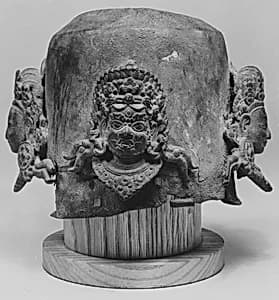
Linga Cover with Four Faces of Shiva (Caturmukhalinga)
Unknown Artist
15th century
Medium
Copper alloy
Dimensions
H. 5 3/8 in. (13.7 cm); W. 6 13/16 in. (17.3 cm)
Classification
Metalwork
Culture
Nepal (Kathmandu Valley)
Department
Asian Art
Museum
Metropolitan Museum of Art, New York, NY
Credit
Anonymous Gift, 1986
Accession Number
1986.509.2
Rights
Public Domain
Tags
Art Historical Context
Nestled in the Metropolitan Museum of Art's Asian Art collection, this exquisite 15th-century copper alloy Linga Cover with Four Faces of Shiva, or *Caturmukhalinga*, hails from Nepal's Kathmandu Valley. Measuring just 5 3/8 inches high and 6 13/16 inches wide, this compact metalwork masterpiece was crafted as a protective dome for a Shiva linga—a sacred, abstract symbol of the Hindu god Shiva's creative energy. Donated anonymously in 198, it exemplifies the valley's renowned tradition of fine bronze casting during the Malla dynasty era. The four intricately carved faces represent Shiva's *caturmukha* form, embodying his omnipresence across the four cardinal directions and aspects of omniscience, destruction, and preservation. This design draws from ancient Shaivite iconography, blending tantric and devotional Hinduism prevalent in medieval Nepal, where Hindu and Buddhist arts flourished side by side. Copper alloy, a durable and malleable medium, allowed artisans to achieve sharp details through lost-wax casting, highlighting the faces' serene expressions and ornate headdresses. As a ritual object for temple worship, this linga cover invites devotees to meditate on Shiva's cosmic unity. Its survival speaks to the enduring spiritual legacy of Kathmandu's metalworkers, whose techniques influenced South Asian sculpture for centuries. A true gem for visitors pondering divinity in miniature form!