
Lion Mask
Unknown Artist
early 12th century
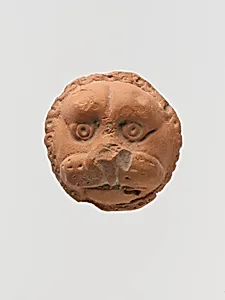
Medium
Terracotta
Dimensions
2 x 2 in. (5.1 x 5.1 cm)
Classification
Sculpture
Culture
Central Asia
Department
Asian Art
Museum
Metropolitan Museum of Art, New York, NY
Credit
Rogers Fund, 1930
Accession Number
30.32.65
Rights
Public Domain
Tags
Art Historical Context
This small terracotta lion mask, created in Central Asia during the early th century, offers a into the region’s richural traditions. Measuring just two inches square, the piece likely served as an architectural ornament or decorative fitting, perhaps adorning a palace, temple, or civic building. Terracotta’s durability and ease molding made it a favored across Central Asia, artisans to produce intricate details that could withstand time and weather. The lion motif carries deep symbolic weight in many Central Asian cultures, often representing strength, protection, and royal authority. Such masks may have functioned apotropaically, warding off evil or invoking guardianship. Though the artist remains unknown, the work reflects the era’s blend of local craftsmanship with broader influences from Persian, Turkic, and Islamic artistic currents. Acquired by the Metropolitan Museum of Art in 1930 through the Rogers Fund, this modest sculpture highlights how even tiny fragments can illuminate the architectural and cultural life of medieval Central Asia.