
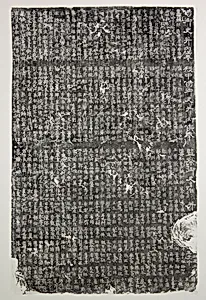
List of Censors, engraved on the back of the Stele for Yushitai Jingshe (1977.375.26)
Unknown Artist
20th century
Medium
Ink on paper
Dimensions
Image: 39 3/16 × 25 3/16 in. (99.5 × 64 cm)
Classification
Rubbing
Culture
China
Department
Asian Art
Museum
Metropolitan Museum of Art, New York, NY
Credit
Seymour and Rogers Funds, 1977
Accession Number
1977.375.27
Rights
Public Domain
Art Historical Context
This striking ink rubbing, titled *List of Censors, on the back of thele for Yushitaiingshe*, captures a piece of Chinese imperial history. Created in the 20th century by an artist, it reproduces inscriptions from a stele—a monumental stone slab—dedicated to the Yushitai Jingshe, likely to the Censorate (Yushitai), an ancient bureaucratic office responsible for oversight, moral remonstrance, and the emperor's adherence to Confucian principles. Measuring nearly 40 by 25 inches, this large-format work hangs in the Metropolitan Museum of Art's Asian Art department, acquired through the Seymour and Rogers Funds in 1977. Rubbings like this one represent a cherished Chinese artistic and scholarly tradition dating back centuries. Artisans placed damp rice paper over the engraved stone surface, then gently inked it to transfer the precise calligraphy and text, preserving fragile inscriptions against erosion. This technique not only safeguarded historical records but also celebrated the elegance of classical script, blending preservation with aesthetic appreciation. The content—a meticulous list of censors—highlights the rigid hierarchy and moral backbone of China's imperial administration, where these officials played a pivotal role in upholding justice and ethics. For visitors, it offers a window into the enduring cultural value of bureaucracy and scholarship in Chinese society, reminding us how stone and ink bridge past and present.