
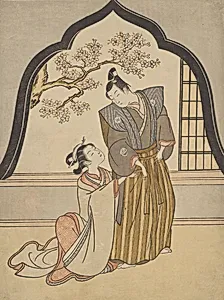
Lovers Dressing Beside a Window
1765
Medium
Color woodblock print; chuban, surimono
Dimensions
27.8 × 20.8 cm (10 7/8 × 8 1/8 in.)
Classification
woodblock print
Department
Arts of Asia
Museum
Art Institute of Chicago
Accession Number
20915
Rights
Public Domain
Art Historical Context
Suzuki Harunobu's *Lovers Dressing Beside a* (1765) captures an intimate moment in the floating world of ukiyo-e, Japan's vibrant print culture of the Edo period. This color woodblock print depicts a tender scene of lovers adjusting their robes by a sunlit window, blending eroticism with everyday elegance. Harunobu a pioneering master of the genre, revolutionized printmaking that year by introducing full-colornishiki-e* (brocade pictures), using multiple woodblocks for up to 10 hues, achieving unprecedented vibrancy and depth. As a *chuban* surimono—a medium-sized, privately commissioned print often featuring poetry—this work exemplifies luxury craftsmanship. Surimono were elite gifts, embellished with mica, embossing, or gold, reserved for New Year's exchanges among literati. Harunobu's delicate lines and subtle shading highlight the figures' graceful forms and patterned kimonos, evoking the refined sensuality of *bijin-ga* (pictures of beautiful women). Housed in the Art Institute of Chicago's Arts of Asia collection, this 27.8 × 20.8 cm gem reflects 18th-century Japan's urban pleasures amid samurai rule, offering visitors a window into a world where art celebrated fleeting beauty and human connection.
About the Artist
Suzuki Harunobu · 1725–1770
Suzuki Harunobu (c. 1725-1770) was a Japanese ukiyo-e artist who revolutionized woodblock printing by developing nishiki-e—full-color prints using multiple woodblocks—in 1765. Before Harunobu, Japanese prints were limited to two or three colors; his innovation unleashed the entire artist's palette, transforming ukiyo-e into the vibrant art form that would later captivate Western artists from Manet...