
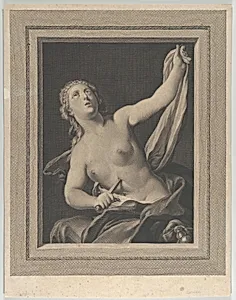
Lucretia seated, half naked, stabbing herself in the stomach with a dagger in her right hand and holding a cloth in her raised left hand, looking upwards, after Pellegrini?
Medium
Engraving
Dimensions
Sheet: 19 7/8 × 15 3/8 in. (50.5 × 39 cm)
Classification
Prints
Department
Drawings and Prints
Museum
Metropolitan Museum of Art, New York, NY
Credit
Harris Brisbane Dick Fund, 1947
Accession Number
47.100.477
Rights
Public Domain
Tags
Art Historical Context
Behold the poignant engraving *Lucretia Seated, Half Naked, Stabbing Herself in the Stomach with a Dagger*, created by French engraver Louis Jacques Cat in 1782, likely after a composition by the Venetian Rococo master Giovanni Antonio Pellegrini ( possible ties to Andrea Casali). dramatic print captures Lucretia in her final moments: seated, partially nude, thrusting a dagger into her abdomen with her right hand while raising a cloth in her left, her gaze lifted heavenward in anguish and resolve. Measuring nearly 20 by 15 inches, its large sheet size amplifies the emotional intensity, making it a striking example of 18th-century reproductive printmaking. Lucretia’s story, drawn from ancient Roman history as recounted by Livy and Ovid, embodies chastity and virtue. Ravished by the tyrant Sextus Tarquinius, she revealed her assault to her family before taking her own life, igniting the revolt that ended Rome’s monarchy and birthed the Republic. This tale inspired countless artists from the Renaissance through the Neoclassical era, symbolizing female honor amid patriarchal violence—a theme resonant in an age of Enlightenment ideals and revolutionary fervor. As an engraving, Cathelin’s meticulous technique—incising fine lines into a metal plate for rich tonal depth—allowed widespread dissemination of Pellegrini’s Baroque dynamism into the precise, heroic style of late 18th-century Europe. Housed in the Metropolitan Museum of Art’s Drawings and Prints department (Harris Brisbane Dick Fund, 1947), this work highlights how prints democratized grand subjects, blending sensuality with moral gravity for enlightened audiences.