
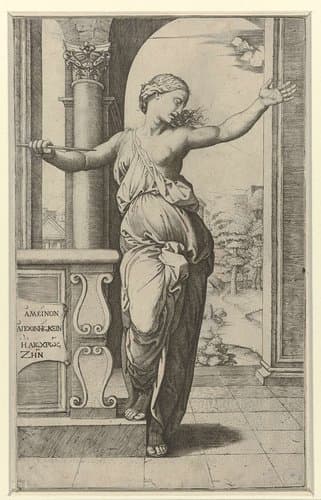
Lucretia staat op punt zichzelf te doden met dolk
1509 - 1514
Medium
engraving
Dimensions
130; 212
Rights
Public Domain
About this artwork
Lucretia staat op het punt zichzelf te doden met een dolk. Op de balustrade naast haar is een griekse tekst weergegeven.
Art Historical Context
This engraving by Marcantonio Raimondi the dramatic final moment of Lucretia, the legendary Roman heroine who chose death over dishonor after her assault by the tyrannical prince Tarquin. Created between 1509 and 1514, the print shows her poised with a dagger, embodying Renaissance ideals of virtue, sacrifice, and moral resolve. The presence of Greek text on the balustrade beside her adds a layer of classical learning, linking the scene directly to ancient sources and inviting viewers to reflect on the story’s political consequences—the founding of the Roman Republic. Raimondi, one of the most skilled engravers of the Italian Renaissance, specialized in translating the compositions of painters like Raphael into finely detailed prints. The engraving medium allowed this image to circulate widely across Europe, making a powerful narrative accessible beyond the walls of palaces and churches. At just 212 by 130 millimeters, the work demonstrates remarkable precision in line work and shading, conveying both the tension of the moment and the sculptural quality of Lucretia’s figure. As a cultural artifact, the print reflects the period’s fascination with ancient Roman heroines as models of female strength and civic duty. It stands as both an artistic achievement and a vehicle for humanist ideas, bringing classical tragedy into the hands of a broader audience.
About the Artist
Marcantonio Raimondi · 1475–1534
Marcantonio Raimondi (c. 1480–1534), born near Bologna, Italy, emerged as one of the Renaissance's premier engravers, revolutionizing printmaking through his mastery of reproductive techniques. He trained in the workshop of the goldsmith, painter, and niellist Francesco Francia, whose influence is evident in his early engravings, such as the goldsmith-like shading in *Pyramus and Thisbe* (1505), h...