
Maart
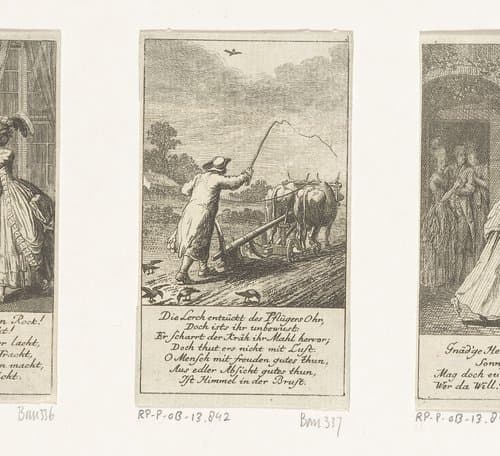
Medium
etching
Dimensions
92; 53
Rights
Public Domain
About this artwork
ets
Art Historical Context
Daniel Nikolaus Chodowie (1726–1801), a leading engraver and illustrator of 18th-century Germany, created *Maart* in 1777. Born in Danzig (now Gdańsk) to a Polish family, Chodowiecki settled in Berlin, where he became renowned for his delicate genre scenes depicting everyday life, moral vignettes, and social customs. Working in the transitional Rococo-to-Neoclassical style, he produced thousands of prints that brought art to a wider beyond elite patrons, often illustrating literature by authors like Goethe and Lessing. This intimate etching, measuring just 92 × 53 mm, exemplifies Chodowiecki's mastery of the medium. Etching allowed him to achieve fine, expressive lines through acid-etched copper plates, capturing subtle textures and narrative detail in small formats ideal for books, albums, or popular collections. *Maart*—Dutch or German for "March"—likely evokes the transitional moods of late winter or early spring, a common theme in Chodowiecki's monthly series, reflecting Enlightenment-era fascination with nature's cycles and human labor. Chodowiecki's works hold cultural significance as vivid snapshots of Prussian society during the reign of Frederick the Great, blending humor, sentiment, and realism. Today, they offer museum visitors a window into 18th-century life, preserved through this precise, reproducible technique that democratized visual storytelling.
About the Artist
Daniel Nikolaus Chodowiecki · 1726–1801
Daniel Nikolaus Chodowiecki (1726–1801) was a German painter and printmaker of Polish-Huguenot descent who became the most celebrated graphic artist in 18th-century Germany. Born in Danzig (now Gdańsk), he created approximately 2,000 etchings that serve as an invaluable visual record of German bourgeois life during the Enlightenment. Largely self-taught, Chodowiecki moved to Berlin in 1743 and ach...