
Macbeth V (The Vision of Lady Macbeth)
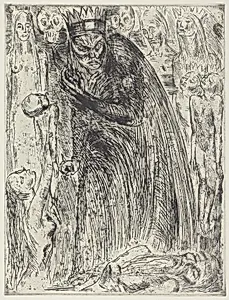
Medium
Etching and drypoint
Classification
Department
CG-W
Museum
National Gallery of Art, Washington, D.C.
Credit
Rosenwald Collection
Accession Number
1944.2.39
Rights
Public Domain
Art Historical Context
Wilhelm Lehmbruck's *Macbeth V (The of Lady Macbeth)*, in 1918, the haunting psychological torment of Shakespeare's tragic figure during her infamous sleepwalking scene. As a leading German Expressionist, Lehmbruck was renowned for his elongated, emotive figures that conveyed profound inner anguish—a style honed through sculpture and extended to printmaking amid the devastation of World War I. This etching, part of a series inspired by *Macbeth*, reflects the own wartime grief, including the loss of his son, infusing the work with raw emotional depth. Printed using etching and drypoint techniques, the piece showcases Lehmbruck's mastery of intaglio methods. Etching provides precise lines etched by acid, while drypoint adds velvety burrs from direct needle engraving, yielding rich tonal contrasts and a sense of ghostly immediacy. These methods allowed for intimate, expressive details, making the print a poignant counterpoint to his monumental sculptures. Housed in the National Gallery of Art's Rosenwald Collection, this work bridges literature, theater, and visual art, inviting visitors to ponder guilt, madness, and human frailty. Lehmbruck's final years produced such introspective gems before his untimely death in 1919, cementing his legacy in early 20th-century modernism.
About the Artist
Wilhelm Lehmbruck · 1881–1919
Wilhelm Lehmbruck (1881–1919) was a German sculptor whose elongated, melancholic figures rank among the most moving works produced by European Expressionism. Born in Duisburg-Meiderich into a working-class family, Lehmbruck studied at the School of Arts and Crafts in Düsseldorf and later at the Düsseldorf Academy, where he mastered the academic tradition before pushing beyond it toward a more pers...