
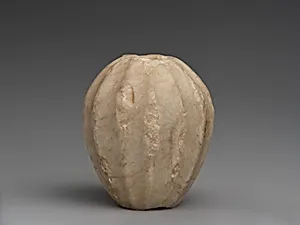
Mace head
Unknown Artist
ca. 2700–2600 BCE
Medium
Stone
Dimensions
2 3/4 in. (7 cm)
Classification
Stone-Implements
Period
Early Dynastic I-II
Department
Ancient Near Eastern Art
Museum
Metropolitan Museum of Art, New York, NY
Credit
Rogers Fund and Gifts of Lucy W. Drexel, Theodore M. Davis, Helen Miller Gould, Albert Gallatin, Egypt Exploration Fund and Egyptian Research Account, by exchange, 1950
Accession Number
51.25.8
Rights
Public Domain
Art Historical Context
This exquisite stone mace head, to around 2700–2600 BCE, hails from the Early Dynastic I-II period in ancient Mesopotamia, a cradle of civilization in the Ancient Near East. Crafted during the rise of Sumerian city-states like Uruk and Ur, it reflects the technological prowess and social hierarchies of a society transitioning from prehistoric villages to urban power centers. At just 2 3/4 inches (7 cm) tall, its compact form belies its role as a potent symbol of authority. Carved from durable stone and meticulously polished, the mace head exemplifies Early Dynastic craftsmanship. Stone was prized for such implements due to its hardness and availability, allowing artisans to shape lethal or ceremonial weapons that could be hafted onto wooden handles. While undecorated examples like this one prioritize function, the smooth finish hints at ritualistic or elite use, evoking the maces wielded by kings and warriors in Mesopotamian art and epics. Today, housed in the Metropolitan Museum of Art's Ancient Near Eastern Art department, this artifact offers a tangible link to humanity's first empires. It underscores how everyday tools doubled as status symbols, illuminating the martial culture that shaped one of the world's earliest writing systems and monumental architecture. A small treasure with big stories!