
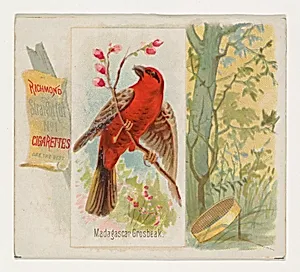
Madagascar Grosbeak, from the Song Birds of the World series (N42) for Allen & Ginter Cigarettes
Medium
Commercial color lithograph
Dimensions
Sheet: 2 7/8 x 3 1/4 in. (7.3 x 8.3 cm)
Classification
Prints|Ephemera
Department
Drawings and Prints
Museum
Metropolitan Museum of Art, New York, NY
Credit
The Jefferson R. Burdick Collection, Gift of Jefferson R. Burdick
Accession Number
63.350.202.42.23
Rights
Public Domain
Tags
Art Historical Context
Welcome to the Metropolitan Museum of Art's Drawings and Prints department, where we spotlight this charming *Madagascar Grosbeak from the *Song Birds of the World* series (N42), issued by Allen & Ginter Cigarettes in1890. Produced by the Philadelphia lithographers George S. & Sons, this petite commercial color lithograph (just 2 7/8 x 3 1/4 inches) the exotic bird in vivid detail, perched against a subtle backdrop that highlights its plumage. In the late 19th, tobacco companies like Allen & Ginter revolutionized by tucking collectible cards into cigarette packs, sparking a craze among enthusiasts. These ephemera educated the public on natural history—here, showcasing the rare Madagascar Grosbeak from the Indian Ocean island—while blending art with commerce. Chromolithography allowed for affordable, eye-catching color reproduction, making ornithological wonders accessible to everyday collectors who pasted them into albums. Today, part of The Jefferson R. Burdick Collection (a generous gift to the Met), this card reflects Victorian fascination with global wildlife and the dawn of mass-produced imagery. A tiny window into a birdwatcher's world, it reminds us how everyday objects fueled curiosity and conservation awareness.
About the Artist
Allen & Ginter|George S. Harris & Sons
Allen & Ginter, the pioneering American tobacco firm based in Richmond, Virginia, emerged around 1880 from the partnership of John F. Allen and Lewis Ginter, evolving from Allen's earlier John F. Allen & Company. Allen retired in 1882, succeeded by John Pope, yet the brand endured under Ginter's leadership, employing over 1,100 workers—mostly women—for hand-rolled cigarettes by 1886. Ginter, a Dut...