
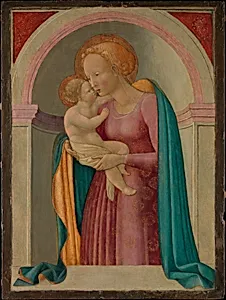
Madonna and Child
Medium
Tempera and gold on wood
Dimensions
29 5/8 x 22 1/4 in. (75.2 x 56.5 cm)
Classification
Paintings
Department
European Paintings
Museum
Metropolitan Museum of Art, New York, NY
Credit
Theodore M. Davis Collection, Bequest of Theodore M. Davis, 1915
Accession Number
30.95.254
Rights
Public Domain
Tags
Art Historical Context
This enchanting panel painting, *Madonna and Child*, was created by the anonymous artist known as the Master of the Lanckoronski Annunciation, whose identity remains a mystery. Like many European painters of the period, this master is named after a key work—in this case, an Annunciation scene once owned by the Lanckoronski family. The painting’s intimate scale suggests it was intended for private devotion, inviting quiet contemplation in a domestic setting rather than a grand public space. Executed in tempera and gold on wood, the work exemplifies traditional techniques that allowed artists to achieve luminous color and delicate detail. The gold ground and halos, applied as thin leaves and often tooled with patterns, evoke a heavenly realm, while the tempera medium—pigments bound with egg yolk—provided a smooth surface ideal for the tender modeling of the Virgin’s face and the Christ Child’s form. Such materials reflect both the spiritual purpose and the technical sophistication of late medieval and early Renaissance panel painting. Acquired by the Metropolitan Museum through the bequest of Theodore M. Davis in 1915, the panel continues to speak to viewers across centuries. It embodies the enduring cultural importance of the Madonna and Child theme, offering a timeless image of maternal love and divine protection rendered with remarkable grace and restraint.