
Maffet Ledger: Drawing
Unknown Artist
ca. 1874–81
Medium
Graphite, watercolor, and crayon on paper
Dimensions
H. 11 3/4 × D. 5 1/4 in. (29.8 × 13.3 cm)
Classification
Paper-Drawings
Culture
Southern and Northern Cheyenne
Department
Arts of Africa, Oceania, and the Americas
Museum
Metropolitan Museum of Art, New York, NY
Credit
The Michael C. Rockefeller Memorial Collection, Purchase, Nelson A. Rockefeller Gift, 1968
Accession Number
1978.412.207 (142)
Rights
Public Domain
Tags
Art Historical Context
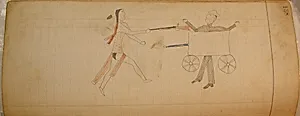
Step into the vivid world of Plains Indian ledger art with this drawing from the *Maffet Ledger*, by an unknown Southern and Northern Cheyenne artist around 1874–81. During this turbulent era, following devastating conflicts like the Sand Creek Massacre and the of Little Bighorn Cheyenne people were confined to reservations. Ledger drawings emerged as a powerful form of visual storytelling, using salvaged paper from accountants' ledgers—hence the name—to chronicle warrior feats, daily life, and cultural narratives that might otherwise be lost. Crafted with graphite, watercolor, and crayon on paper (measuring 11 3/4 × 5 1/4 inches), this intimate work exemplifies the genre's bold, linear style. Fine graphite outlines define dynamic figures of men and women, brought to life with vibrant watercolors and crayon highlights. Unlike traditional hide paintings, the shift to paper allowed for portability and preservation, blending Indigenous iconography—such as symbolic motifs for status and action—with accessible European materials. Housed in The Metropolitan Museum of Art's Arts of Africa, Oceania, and the Americas department, this piece from The Michael C. Rockefeller Memorial Collection offers a poignant glimpse into Cheyenne resilience. It preserves cultural memory amid colonization, inviting us to appreciate the artistry born from adversity.