
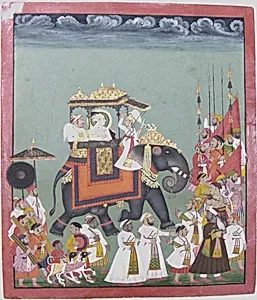
Maharana Raj Singh II in Procession with Members of His Court
Unknown Artist
ca. 1755
Medium
Ink, opaque watercolor, and gold on paper
Dimensions
Page 17 1/8 x 14 1/2 in. (43.5 x 36.8 cm)
Classification
Paintings
Culture
India (Rajasthan, Mewar)
Department
Asian Art
Museum
Metropolitan Museum of Art, New York, NY
Credit
Cynthia Hazen Polsky and Leon B. Polsky Fund, 2004
Accession Number
2004.408
Rights
Public Domain
Tags
Art Historical Context
This vibrant painting from the Mewar court in Rajasthan, India, captures Maharana Raj Singh II (r. 1761–1773) in a grand procession with his courtiers, elephants, and even loyal dogs. Created around 1755 by an unknown, it exemplifies the Rajput miniature tradition, which flourished in princely states like Mewar amid political tensions with the Mughal Empire. Such works celebrated royal power and pageantry, often commissioned to document rulers' triumphs and daily splendor, offering a window into 18th-century Hindu Rajput life. Rendered in ink, opaque watercolor, and gold on paper—a hallmark of Indian court painting—the artwork showcases meticulous brushwork and vivid hues that bring the procession to life. The flattened perspective and intricate details, from embroidered textiles to the majestic elephants, highlight the technical mastery of Mewar artists, who blended Persian influences with indigenous styles for dynamic storytelling. Housed in the Metropolitan Museum of Art's Asian Art collection, this piece underscores Mewar's cultural resilience and artistic patronage, inviting viewers to imagine the rhythmic march of a royal entourage through Rajasthan's palaces and plains.