
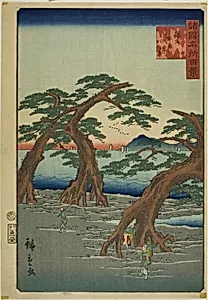
Maiko Beach, Banshu Province (Banshu Maiko no hama) from the series “One Hundred Famous Views in the Various Provinces (Shokoku meisho hyakkei)”
Medium
Color woodblock print
Classification
woodblock print
Department
Arts of Asia
Museum
Art Institute of Chicago
Accession Number
196753
Rights
Public Domain
Art Historical Context
**Maiko Beach, Banshu** by Utagawa Hirosh II (Shigenobu) is a captivating color woodblock print from 1859, part of series *One Hundred Famous in the Various Provinces (Shokoku meisho hyakkei)*. during Japan's late Edo period, this work showcases Hiroshige II's mastery in the ukiyo-e tradition, a genre that celebrated the "floating world of everyday beauty, landscapes, and famous sites. As a pupil and adopted son of the renowned Hiroshige I, he continued his mentor's legacy of poetic depictions of nature, bringing the serene shores of Maiko Beach in Banshu Province (modern-day Hyogo Prefecture) to life for urban audiences in Edo (Tokyo). The print's historical significance lies in its role within a broader ukiyo-e trend of provincial travel views, which romanticized Japan's diverse regions amid growing domestic tourism via new roads and guidebooks. Woodblock printing, involving multiple carved blocks for layered colors, allowed affordable mass production—up to thousands of impressions—democratizing art and influencing global aesthetics, from Impressionism to Japonisme. Held in the Art Institute of Chicago's Arts of Asia collection, this piece invites us to savor the fleeting beauty of coastal vistas, evoking the tranquility and cultural pride of 19th-century Japan. (198 words)
About the Artist
Utagawa Hiroshige II (Shigenobu) · 1826–1869
Utagawa Hiroshige II, born Suzuki Chinpei in 1826, was one of the most accomplished ukiyo-e artists of mid-nineteenth century Japan. He entered the studio of the celebrated landscape master Utagawa Hiroshige I — known for his iconic series "The Fifty-three Stations of the Tokaido" — and proved himself the most talented of the elder artist's few students. So highly regarded was the young pupil that...