
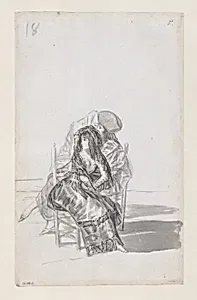
Maja seated on a chair and two companions behind; folio 18 (verso) from the Madrid Album 'B'
Medium
Brush and point of brush, carbon black washes, on laid paper
Dimensions
Sheet: 9 1/4 x 5 3/4 in. (23.5 x 14.61cm)
Classification
Drawings
Department
Drawings and Prints
Museum
Metropolitan Museum of Art, New York, NY
Credit
Harris Brisbane Dick Fund, 1935
Accession Number
35.103.5
Rights
Public Domain
Tags
Art Historical Context
In the late 1790s, Francisco de Goya y Lucientes, Spain's foremost painter of the Romantic era, filled his private Madrid Albums with intimate, observational drawings that captured the vibrancy and underbelly of everyday life in Madrid. This work, folio 18 (verso) from Album 'B' (1795–97), depicts a stylish *maja*—a bold, fashionably dressed woman of the working class—seated confidently on a chair, flanked by two companions standing behind her. These albums were Goya's personal sketchbooks, free from the constraints of patronage, allowing him to experiment with social satire, character studies, and the raw energy of urban Spain during a time of political upheaval and Enlightenment ideals. Rendered in brush and point of brush with carbon black washes on laid paper (9¼ × 5¾ in.), the drawing showcases Goya's masterful command of monochrome tones. The fluid washes create dramatic chiaroscuro effects, highlighting the maja's poised posture and the expressive gestures of her companions, blending portraiture with caricature. This technique, economical yet evocative, foreshadows Goya's later print series like *Los Caprichos*, revealing his shift toward psychological depth and critique of class and gender dynamics. Housed in The Metropolitan Museum of Art's Drawings and Prints department (Harris Brisbane Dick Fund, 1935), this intimate sheet offers visitors a glimpse into Goya's creative process, immortalizing the spirited *majas* who symbolized Madrid's cultural flair amid encroaching turmoil.
About the Artist
Goya (Francisco de Goya y Lucientes) · 1746–1828
Francisco José de Goya y Lucientes (1746-1828) was a Spanish painter and printmaker considered the last of the Old Masters and the first of the moderns. Rising from modest provincial origins to become First Court Painter to Charles IV, Goya's career spanned the Enlightenment's optimism and the brutal Napoleonic invasion that shattered it. A mysterious illness in 1793 left him permanently deaf and ...