
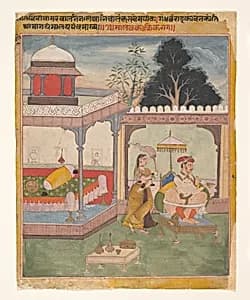
Malavakusika Raga: Page from a Dispersed Ragmala Series (Garland of Musical Modes)
Unknown Artist
early 17th century
Medium
Ink, opaque watercolor, and gold on paper
Dimensions
Image: 8 5/8 x 7 3/8 in. (21.9 x 18.7 cm)
Classification
Paintings
Culture
India (Rajasthan, Amber?)
Department
Asian Art
Museum
Metropolitan Museum of Art, New York, NY
Credit
Gift of Cynthia Hazen Polsky, 1987
Accession Number
1987.424.14
Rights
Public Domain
Tags
Art Historical Context
This exquisite page from a dispersed *Ragmala* series, titled *Malavakusika Raga*, hails from early 17th-century Rajasthan, likely the Amber region (modern-day Jaipur). *Ragmala* paintings or "garlands of musical modes," a cherished tradition in Indian courts, interpreting the *ragas*—melodic frameworks of Hindustani classical music. Each raga evokes a specific mood or time of day, often through poetic narratives of lovers. Here, the *Malavakusika Raga*, associated with romance and longing, likely depicts an intimate scene of a man and woman on a lavish bed, surrounded by architectural details and lush foliage. Crafted by an unknown artist in the vibrant Rajasthani miniature style, the work employs ink for precise outlines, opaque watercolor for bold, saturated hues, and gold for shimmering highlights, creating a jewel-like luminosity on paper. Measuring just 8⅝ × 7⅜ inches, it exemplifies the technical mastery of these pocket-sized masterpieces, produced for royal patrons under Mughal-influenced Rajput ateliers. Culturally, *Ragmala* series bridged music and visual art, aiding performers in conjuring a raga's *rasa* (emotional essence). Now at the Metropolitan Museum of Art, gifted by Cynthia Hazen Polsky in 1987, this fragment invites us to imagine its full "garland," harmonizing sight and sound in India's rich artistic heritage.