
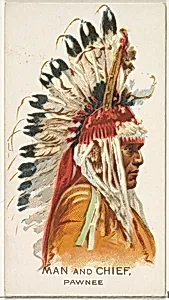
Man and Chief, Pawnee, from the American Indian Chiefs series (N2) for Allen & Ginter Cigarettes Brands
1888
Medium
Commercial color lithograph
Dimensions
Sheet: 2 3/4 x 1 1/2 in. (7 x 3.8 cm)
Classification
Prints|Ephemera
Department
Drawings and Prints
Museum
Metropolitan Museum of Art, New York, NY
Credit
The Jefferson R. Burdick Collection, Gift of Jefferson R. Burdick
Accession Number
63.350.201.2.22
Rights
Public Domain
Tags
Art Historical Context
Step into the vibrant world of 19th-century American ephemera with *Man and Chief, Paw*, a colorful card from Allen & Ginter's *American Indian Chiefs* seriesN2), issued in 1888. Produced by the pioneering tobacco company Allen & Ginter, these prints (just 2¾ x 1½ inches) were tucked into cigarette packs as promotional collectibles, sparking a craze for trading cards among enthusiasts. This piece captures profiles of Pawnee figures—a chief and companion—highlighting Native American leaders during an era of rapid westward expansion and romanticized "Wild West" imagery. Crafted as a commercial color lithograph, the artwork showcases chromolithography's breakthrough: layering vibrant hues through multiple stone plates for mass-produced brilliance on a budget. Though diminutive, its sharp details and bold profiles reflect ethnographic portraiture trends, blending admiration with the period's often stereotypical gaze on Indigenous peoples. Pawnee culture, from the Great Plains, was known for skilled horsemanship and earth-lodge villages, adding layers of historical intrigue. Today, housed in the Metropolitan Museum of Art's Jefferson R. Burdick Collection, this ephemera gem reveals how everyday commerce preserved cultural snapshots, transforming humble inserts into treasured artifacts of Gilded Age America.
About the Artist
Allen & Ginter
Allen & Ginter, the pioneering American tobacco firm based in Richmond, Virginia, emerged around 1880 from the partnership of John F. Allen and Lewis Ginter, evolving from Allen's earlier John F. Allen & Company. Allen retired in 1882, succeeded by John Pope, yet the brand endured under Ginter's leadership, employing over 1,100 workers—mostly women—for hand-rolled cigarettes by 1886. Ginter, a Dut...