
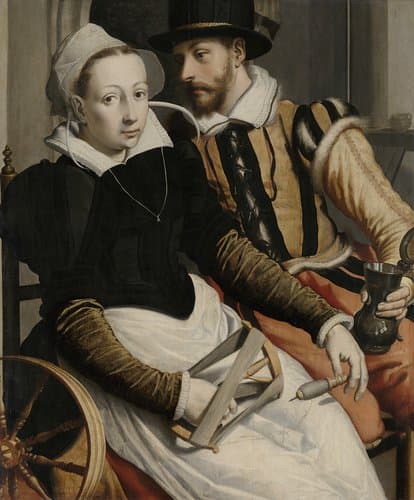
Man en vrouw bij een spinnewiel
c. 1560 - c. 1570
Medium
oil on panel
Dimensions
3.5; 63; 76
Rights
Public Domain
About this artwork
buitenmaat: diepte 3,5 cm (drager incl. SK-L-2416)
Art Historical Context
In the tranquil glow of a 16th-century Dutch interior, Pieter Pietersz (I)'s *Man en vrouw bij eennewiel* (c. 1560–1570) captures a tender moment of everyday life. Painted in oil on panel—a favored medium among Northern Renaissance artists for its smooth surface and ability to render fine details—this intimate work measures 76 × 63 cm. Housed in the Rijksmuseum (inv. SK-L-2416), it exemplifies the emerging Dutch genre tradition, where humble domestic scenes began to rival religious subjects in popularity. Pieter Pietersz., a Haarlem painter from a family of artists, specialized in such vignettes of peasant life, often infused with subtle moral or social commentary. Here, a man and woman share space near a spinning wheel, evoking themes of companionship, labor, and domestic harmony amid the turbulent Reformation era in the Netherlands. The spinning wheel, a symbol of industriousness and femininity, underscores the cultural value placed on household productivity during this pre-Golden Age period. Artistically, the oil technique allows for rich glazing and meticulous textures, from the woman's flowing skirts to the wooden panel's warm patina. This panel not only showcases Pietersz.'s skill in creating lifelike intimacy but also bridges late medieval symbolism with the secular realism that would define later masters like Vermeer, offering visitors a window into 16th-century Dutch hearth and home.