
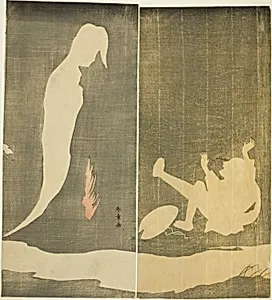
Man Falling Backward, Startled by a Woman's Ghost over a River
c. 1782
Medium
Color woodblock print; hosoban diptych
Dimensions
Right: 31.5 × 14.2 cm (12 3/8 × 5 9/16 in.); Left: 31.7 × 14.2 cm (12 1/2 × 5 9/16 in.)
Classification
woodblock print
Department
Arts of Asia
Museum
Art Institute of Chicago
Accession Number
88324
Rights
Public Domain
Art Historical Context
In the vibrant world of Edo-period Japan (1603–1868), Katsukawa Shunsho (1726–1792), a ukiyo-e master of the Katsukawa school, captured fleeting moments of drama and the supernatural. This color woodblock print diptych, titled *Man Falling Backward, Startled by a Woman's Ghost over a River* (c. 1782), exemplifies the hosoban format—a narrow, vertical design (each panel about 31.5 × 14.2 cm) ideal for intimate scenes or actor portraits. Shunsho's precise lines and bold colors, achieved through intricate woodblock carving and multiple color blocks (nishiki-e technique), brought everyday thrills to life for urban audiences. The scene unfolds with dynamic tension: a man tumbles backward in terror as a ethereal female ghost hovers above a misty river, her flowing robes and pale form evoking yokai folklore—restless spirits from Japanese tales. This ghostly encounter reflects the era's fascination with the "floating world" (ukiyo), blending humor, horror, and human emotion in popular culture, often inspired by kabuki theater or ghost stories like those in *Hyaku Monogatari*. Housed in the Art Institute of Chicago's Arts of Asia collection, this diptych highlights Shunsho's influence on later masters like Hokusai. Its small scale made it affordable and collectible, democratizing art and preserving cultural narratives of the uncanny for generations.