
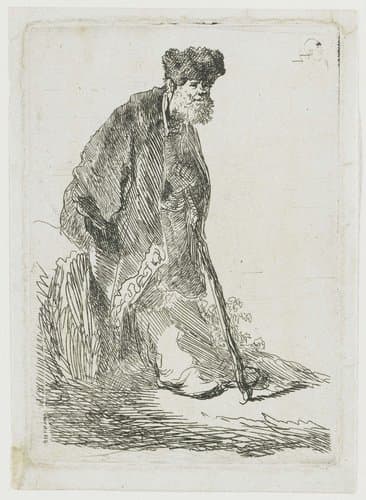
Man in a coat and fur cap leaning against a bank
ca. 1630
Medium
etching
Dimensions
113; 80
Rights
Public Domain
About this artwork
verzamelaarsmerk, verso rechtsonder: Lugt 2228
Art Historical Context
In the early 1630s, Rembrandt van Rijn, the eminent Dutch Golden Age master, created this intimate etching titled *Man in a Coat and Fur Cap Leaning Against a Bank* (ca. 1630). Measuring just 113 mm high by 80 mm wide, it exemplifies the artist's innovative use of etching—a printmaking technique where acid bites into a metal plate to form lines. Rembrandt's etchings were revolutionary for their velvety textures, dramatic light effects, and psychological depth, bridging painting and print with unprecedented expressiveness. The subject appears as a "tronie," a Dutch genre of character study capturing an anonymous figure's evocative pose and attire. Here, the man leans casually against what may be a riverbank, his fur cap and heavy coat suggesting a working-class everyman enduring the chill of a Dutch winter. Rembrandt's masterful line work conveys texture—the plush fur, coarse wool—and subtle chiaroscuro, drawing viewers into a moment of quiet introspection. This small gem bears a collector's mark (Lugt 2228) on the verso lower right, a testament to its enduring appeal among connoisseurs. Produced during Rembrandt's formative Leiden-Amsterdam years, it highlights his early prowess in etching, influencing generations of printmakers and cementing his legacy as a virtuoso of light and humanity.
About the Artist
Rembrandt van Rijn · 1606–1669
Rembrandt Harmenszoon van Rijn (1606–1669) stands as one of the greatest visual artists in the history of Western art and the most important Dutch painter of the 17th century. Born in Leiden to a prosperous miller's family, Rembrandt transformed painting through his revolutionary use of light and shadow, his psychological depth in portraiture, and his elevation of etching to a fine art. His approx...