
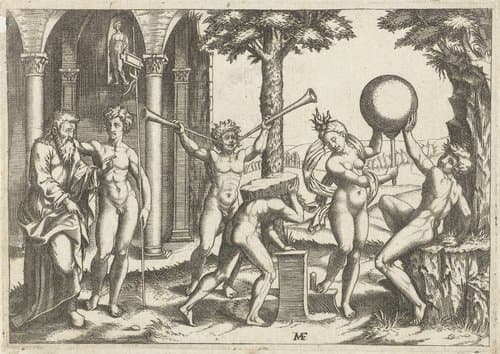
Man met twee trompetten en man met steen op zijn rug geflankeerd door man en vrouw met globe en oude en jonge man
1510 - 1575
Medium
engraving
Dimensions
120; 85
Rights
Public Domain
About this artwork
Prent in spiegelbeeld naar ontwerp van Marcantonio Raimondi.
Art Historical Context
This intriguing engraving, titled *Man met twee trompet en man met steen zijn rug geflanke door man en vrouw met globe en oude en jonge* (translated as "Man with Two Trumpets and Man with on His Back Flanked Man and Woman with Globe and Old and Young Man dates to between 1510 and 1575. Created anonymously but as a mirror-image reproduction of a design by the renowned Italian engraver Marcantonioondi, it measures a compact 85mm by 120mm—ideal for collectors and scholars of the Renaissance era. Raimondi, a master collaborator with Raphael, revolutionized printmaking by translating High Renaissance drawings into widely disseminated engravings, making elite art accessible beyond Italy. The composition bursts with allegorical symbolism: a central figure burdened by a stone evokes endurance or folly, paired with a triumphant man sounding two trumpets, perhaps heralding fame or announcement. They are flanked by a couple holding a globe—symbols of worldly knowledge or exploration—and contrasting old and young men, hinting at life's stages or generational wisdom. Engraving's fine lines allowed precise detail in such crowded scenes, a technique that elevated prints from mere copies to independent artworks during the Northern Renaissance's print boom. This piece reflects the era's fascination with moral and cosmic emblems, bridging Italian design with Northern European production. Though anonymous, its Raimondi origin underscores printmaking's role in cultural exchange, preserving enigmatic narratives for modern eyes.
About the Artist
anonymous
In the vast tapestry of art history, "Anonymous" stands not as a singular individual but as a collective designation for countless unidentified creators whose works have endured across millennia. These artists, spanning prehistoric cave painters to medieval illuminators and folk craftsmen, produced the foundational layers of human visual culture. Prior to the Renaissance, when individual fame emer...