
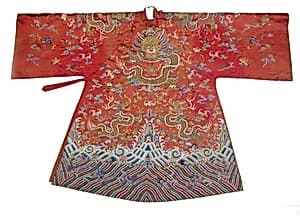
Man or Woman's Jacket, Wedding or Theatrical (?)
Unknown Artist
18th century
Medium
Silk
Dimensions
44 1/4 x 67 in. (112.40 x 170.18 cm)
Classification
Costumes-Embroidered
Culture & Period
China · Qing dynasty (1644–1911)
Department
Asian Art
Museum
Metropolitan Museum of Art, New York, NY
Credit
Bequest of Mrs. James W. Gerard, 1956
Accession Number
56.210.5
Rights
Public Domain
Tags
About this artwork
This sumptuous silk jacket from eighteenth-century Qing dynasty China exemplifies the extraordinary textile arts cultivated during one of Chinese history's most culturally rich periods. The jacket's magnificent dimensions, spanning over sixty-seven inches in width, and its elaborate silk embroidery suggest it may have served ceremonial purposes, perhaps for weddings or theatrical performances where splendor and symbolic meaning took precedence over everyday practicality. During the Qing dynasty ...
Art Historical Context
This exquisite silk jacket from 18th-century Qing dynasty (1644–1911) showcases the pinnacle of Chinese textile artistry during a golden age of cultural splendor. Crafted with elaborate embroidery on luxurious silk, its impressive dimensions—over 67 inches wide—hint at ceremonial use, possibly for weddings or theatrical performances where opulence trumped practicality. The unknown artist employed advanced weaving techniques blended with painterly embroidery, creating a garment that was true wearable art, now preserved at the Metropolitan Museum of Art through the 1956 bequest of Mrs. James W. Gerard. Symbolic motifs like dragons—evident in the design—along with phoenixes, flowers, or auspicious characters, conveyed wishes for prosperity, longevity, and high status. The jacket's ambiguity as man's or woman's attire reflects fluid gender conventions in Chinese court and theater dress, defying Western norms. Vibrant colors and fine materials would have dazzled in candlelit halls or on stage, embodying the wearer's wealth, taste, and sophistication. As a highlight of the Asian Art department's embroidered costumes, this piece invites us to ponder its exact rituals while celebrating Qing innovation in silk production.