
Man Plowing (recto and verso)
n.d.
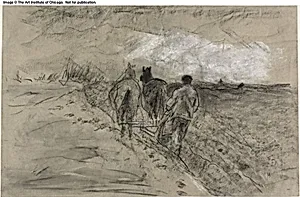
Medium
Black chalk, with white chalk, brush and gray wash, and touches of stumping, on grayish-tan wove paper
Dimensions
29.2 × 45.3 cm (11 1/2 × 17 7/8 in.)
Classification
chalk
Department
Prints and Drawings
Museum
Art Institute of Chicago
Accession Number
112767
Rights
Public Domain
Art Historical Context
Anton Mauve's *Man Plowing (rect and verso)* captures the quiet dignity of rural labor in a delicate drawing executed on both sides of a grayish-tan w paper. Created in black chalk heightened with white chalk, brush and gray wash, and subtle stumping for soft blending, this undated work measures 29.2 × 45.3 cm and Mauve's mastery of mixed media. As a leading figure in the Hague School—a late 19th-century Dutch movement inspired by French Barbizon painters—Mauve celebrated everyday countryside scenes with a realistic touch, emphasizing atmosphere and natural light over idealization. The recto likely features the central figure of a man at work in the fields, rendered with fluid chalk lines and tonal washes that evoke the earthy textures of soil and labor. The verso adds depth, possibly offering studies or variations that reveal Mauve's process of observation and refinement. Wove paper, smooth and versatile, was ideal for such intricate techniques, allowing for the subtle gradations that bring the scene to life. Housed in the Art Institute of Chicago's Prints and Drawings department and classified as chalk drawing, this piece highlights preparatory sketches' role in Mauve's oeuvre. Visitors will appreciate how *Man Plowing* reflects 19th-century fascination with agrarian life amid industrialization, inviting reflection on the timeless rhythm of human effort in harmony with nature. A testament to Mauve's influence—he mentored Vincent van Gogh—this drawing bridges studio practice and poetic realism.
About the Artist
Anton Mauve · 1838–1888
Anton Mauve (1838–1888), born Anthonij Rudolf Mauve in Zaandam, Netherlands, hailed from a family of North Holland clergymen. At age 16, he apprenticed under animal painter Pieter Frederik van Os in Haarlem, mastering depictions of livestock, before studying briefly with Wouterus Verschuur, whose equine subjects instilled a lifelong affinity for horses. He honed his plein air technique alongside P...