
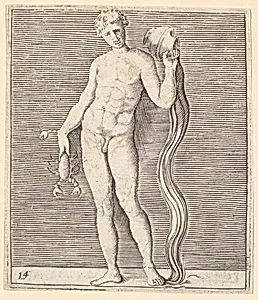
Man with Crayfish and Urn of Water, from "Ex Antiquis Cameorum et Gemmae Delineata/ Liber Secundus/et ab Enea Vico Parmen Incis"
Medium
Engraving; third state
Dimensions
plate: 3 7/16 x 4 7/8 in. (8.8 x 12.4 cm)
Classification
Prints
Department
Drawings and Prints
Museum
Metropolitan Museum of Art, New York, NY
Credit
The Elisha Whittelsey Collection, The Elisha Whittelsey Fund, 1949
Accession Number
49.97.414
Rights
Public Domain
Tags
Art Historical Context
**Man with Crayfish and Ur of Water** This intricate engraving captures a classical motif from an ancient cameo or gem, depicting a nude male figure gracefully handling a crayfish beside an urn of water.rawn from the Renaissance publication *Ex Antiquis Cameorum et Gemmae Delineata Liber Secundus*, exemplifies the era's fascination with rediscovering Greco-Roman artistry. Printed around 1599–1622 as a third-state impression, this small plate (3 7/16 x 4 7/8 in.) allowed widespread dissemination of tiny, precious artifacts that few could own. Engravers like Enea Vico of Parma, alongside contributors such as Battista Franco and influences from collectors like Francesco Angeloni, meticulously translated the gem's low-relief carving into fine lines. Engraving's precision was ideal for replicating the subtle modeling and textures of cameos, making classical ideals of the male nude—strong yet poised—accessible to scholars and artists across Europe. Housed in The Metropolitan Museum of Art's Prints collection, this work highlights the Renaissance humanist drive to revive antiquity. It influenced Mannerist styles and served as a visual textbook for anatomy and mythology, bridging ancient splendor with early modern innovation. A delightful window into how 16th-century Italians breathed new life into the past!
About the Artist
Francesco Angeloni|Battista Franco|Philippe Thomassin|Enea Vico|Anonymous, Italian, 16th century (Italian|Italian|French|Italian|Italian) · 1559 |1510 |1562 |1523 |1500 –1652 |1561 |1622 |1567 |1600
Terni 1559 or 1587–1652 Rome|Italian, Venice ca. 1510–1561 Venice|French, Troyes 1562–1622 Rome|Italian, Parma 1523–1567 Ferrara|