
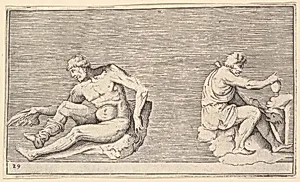
Man with Wing; Man with Vase and Dog, from "Ex Antiquis Cameorum et Gemmae Delineata/ Liber Secundus/et ab Enea Vico Parmen Incis"
Medium
Engraving; third state
Dimensions
plate: 3 7/16 x 4 7/8 in. (8.8 x 12.4 cm)
Classification
Prints
Department
Drawings and Prints
Museum
Metropolitan Museum of Art, New York, NY
Credit
The Elisha Whittelsey Collection, The Elisha Whittelsey Fund, 1949
Accession Number
49.97.429
Rights
Public Domain
Tags
Art Historical Context
This enchanting engraving, titled *Man with Wing; Man with V and Dog*, hails from the second volume of *Ex Antiquis Cameorum Gemmae Delineata ("Drawn from Ancientos and Gems"), published 1599–1622. Crafted as a third-state impression, it faithfully reproduces classical motifs from ancient cameos and intaglios—likely depicting mythological male nudes, one winged figure evoking classical ideals of grace and divinity, and another accompanied by a vase and loyal dog, symbols of everyday antiquity or satyr-like whimsy. Measuring just 3 7/16 x 4 7/8 inches, this intimate print was the work of Italian 16th-century masters including Enea Vico, a renowned engraver from Parma, alongside contributors like Battista Franco and Francesco Angeloni, with later involvement from Philippe Thomassin. In the Renaissance, engravings like this were revolutionary, democratizing access to priceless ancient artifacts hoarded by collectors. Vico's precise burin technique captured the gems' intricate details, from fluid musculature to textured fur and vessels, preserving Greco-Roman artistry for scholars and artists across Europe. Housed in the Metropolitan Museum of Art's Drawings and Prints department (The Elisha Whittelsey Collection, 1949), it exemplifies the era's humanist passion for rediscovering antiquity, bridging classical past and early modern innovation in a single, delicate plate.
About the Artist
Francesco Angeloni|Battista Franco|Philippe Thomassin|Enea Vico|Anonymous, Italian, 16th century (Italian|Italian|French|Italian|Italian) · 1559 |1510 |1562 |1523 |1500 –1652 |1561 |1622 |1567 |1600
Terni 1559 or 1587–1652 Rome|Italian, Venice ca. 1510–1561 Venice|French, Troyes 1562–1622 Rome|Italian, Parma 1523–1567 Ferrara|