
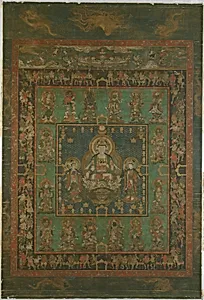
般若菩薩曼荼羅図|Mandala of the Bodhisattva Hannya (Prajnaparamita)
Unknown Artist
14th century
Medium
Hanging scroll; ink, color, gold, and gold foil on silk
Dimensions
Image: 64 1/2 x 48 5/8 in. (163.8 x 123.5 cm) Overall with painted mounting: 83 1/4 x 57 3/4 in. (211.5 x 146.7 cm) Overall with mounting: 126 x 65 1/16 in. (320 x 165.2 cm) Overall with knobs: 126 x 69 11/16 in. (320 x 177 cm)
Classification
Paintings
Culture & Period
Japan · Nanbokuchō period (1336–92)
Department
Asian Art
Museum
Metropolitan Museum of Art, New York, NY
Credit
Mary Griggs Burke Collection, Gift of the Mary and Jackson Burke Foundation, 2000
Accession Number
2000.289
Rights
Public Domain
Tags
Art Historical Context
Nestled in the Metropolitan Museum of Art's Asian Art collection, this stunning 14th-century hanging scroll depicts the Mandala of the Bodhisattva Prajnaparamita (Hannya in Japanese), the embodiment of transcendent wisdom in Mahayana Buddhism. Created by unknown artist during Japan's turbulent Nanbokuchō period (6–92)—a time of civil war between rival imperial courts—the painting measures an impressive 64½ x 48⅝ inches, rendered in ink, vibrant colors, gold, and gold foil on silk. This luxurious medium was typical for esoteric Buddhist artworks, intended for temple rituals or private meditation, where the scroll could be unrolled to reveal its sacred cosmos. At the center reigns Prajnaparamita, surrounded by a vibrant assembly of bodhisattvas, deities, demons, dragons, and musicians, as suggested by the artwork's tags. These figures form a symmetrical mandala, a diagrammatic map of the spiritual universe symbolizing enlightenment's path. The opulent gold foil evokes divine radiance, enhancing the scroll's meditative power amid the era's chaos, when Buddhist art flourished as a source of solace and imperial patronage. This rare survivor from the Mary Griggs Burke Collection highlights Japanese esoteric traditions' artistic mastery, blending intricate linework with luminous hues to guide viewers toward wisdom's profound mysteries.