
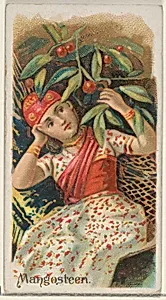
Mangosteen, from the Fruits series (N12) for Allen & Ginter Cigarettes Brands
Medium
Commercial color lithograph
Dimensions
Sheet: 2 3/4 x 1 1/2 in. (7 x 3.8 cm)
Classification
Prints|Ephemera
Department
Drawings and Prints
Museum
Metropolitan Museum of Art, New York, NY
Credit
The Jefferson R. Burdick Collection, Gift of Jefferson R. Burdick
Accession Number
63.350.201.12.29
Rights
Public Domain
Tags
Art Historical Context
Step into the vibrant world of 19th American advertising with *Mangosteen, from Fruits series (N12 for Allen & Ginterarettes Brands* (1891). Produced by Allen & Ginter in collaboration with George S. Harris & Sons this petite chromolithograph was one of many collectible inserts tucked into cigarette packs. Tobacco giants like Allen & Ginter revolutionized marketing by bundling these colorful cards—depicting exotic fruits like the rare mangosteen alongside alluring women—to entice smokers and spark a collecting craze among all ages. Crafted as a commercial color lithograph, the tiny sheet (just 2 3/4 x 1 1/2 inches) showcases the era's mastery of chromolithography, a printing technique that layered vibrant hues for eye-catching realism at low cost. This ephemera bridged fine art and commerce, making high-quality illustrations accessible and turning everyday purchases into treasures. Today, housed in the Metropolitan Museum of Art's Jefferson R. Burdick Collection, it highlights the cultural fusion of exoticism, femininity, and consumer culture in Gilded Age America—reminding us how fruits and fashion fueled both trade and imagination.
About the Artist
Allen & Ginter|George S. Harris & Sons
Allen & Ginter, the pioneering American tobacco firm based in Richmond, Virginia, emerged around 1880 from the partnership of John F. Allen and Lewis Ginter, evolving from Allen's earlier John F. Allen & Company. Allen retired in 1882, succeeded by John Pope, yet the brand endured under Ginter's leadership, employing over 1,100 workers—mostly women—for hand-rolled cigarettes by 1886. Ginter, a Dut...