
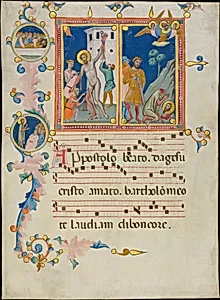
Manuscript Leaf with the Martyrdom of Saint Bartholomew, from a Laudario
ca. 1340
Medium
Tempera, gold, and ink on parchment
Dimensions
Overall: 18 1/2 x 13 3/4 in. (47 x 35 cm) Mat size: 27 7/8 x 22 in. (70.8 x 55.9 cm) Illumination: 6 15/16 x 8 1/16 in. (17.7 x 20.5 cm)
Classification
Manuscripts and Illuminations
Culture
Italian
Department
The Cloisters
Museum
Metropolitan Museum of Art, New York, NY
Credit
The Cloisters Collection, 2006
Accession Number
2006.250
Rights
Public Domain
Tags
Art Historical Context
This exquisite manuscript leaf, created by the Florentine artist Pacino di Bonaguida around1340, comes from a *laudario*—a devotional songbook used by lay religious confraternities in 14th-century Italy for lauds, poetic praises of the Virgin Mary and saints. Titled *Manuscript Leaf with the Martdom of Saint Bartholomew*, captures the dramatic moment of the saint's gruesome execution: flaying alive, a common motif in medieval hagiography symbolizing spiritual purification. Pacino, a master of both panel painting and illumination influenced by Giotto's naturalism, populates the scene with anguished figures, hovering angels, and the saint's tormentors, blending Gothic elegance with emerging Renaissance vitality. Crafted in tempera, gold leaf, and ink on parchment, the leaf exemplifies Trecento illumination techniques. The lavish gold heightens the divine glow, while delicate ink outlines and vibrant tempera colors create a luminous, jewel-like quality ideal for communal worship. Measuring just under 7 by 8 inches in its illuminated area, this fragile page was part of a larger codex, now housed in The Cloisters Collection at the Metropolitan Museum of Art. As a window into Florentine piety during the Black Death era, the work underscores the era's intense focus on martyrdom and salvation, inviting visitors to ponder the saints' endurance amid gold-kissed heavens. A testament to Pacino's skill, it bridges devotional art and storytelling in one radiant survival from medieval Tuscany.